Elena Teslova
12 May 2026•Update: 12 May 2026
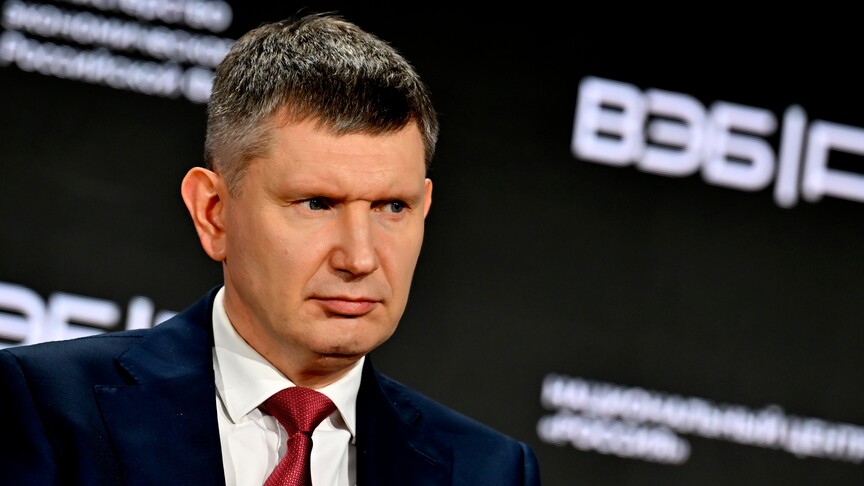
Economic Development Minister Maxim Reshetnikov said on Tuesday that despite sanctions pressure, the Russian economy "has performed very admirably."
Reshetnikov briefed Russian President Vladimir Putin on the current state of the national economy during a meeting in Moscow ahead of a scheduled government discussion on the economy.
According to Reshetnikov, Russia’s economy has expanded by around 10% in real terms over the past three years, while the country currently ranks as the world’s fourth-largest economy by purchasing power parity.
“Despite all the external challenges, sanctions pressure, and structural adjustments, our economy has performed very well,” Reshetnikov said, attributing the results to government decisions and accumulated economic potential.
The minister noted that Russia has significantly narrowed its GDP per capita gap with the US since 2017, while investment volumes have increased by more than 50% in recent years. Currently, investment exceeds 23% of GDP, he added.
"If in 2017 our per capita GDP was 43% of the American GDP, then by the end of 2025 it was already almost 56%. At the same time, we were closing the gap, and, for example, many of our European neighbors, as a rule, widened the gap; that is, they lagged behind the economy," he said.
According to him, this shows that the Russian economy has grown "not only in line with, but also ahead of growth," including in the American economy.
Putin and Reshetnikov also discussed the current economic slowdown. The minister acknowledged that GDP declined during the first two months of the year but said growth resumed in March.
“It is probably still premature to speak about a full recovery in the growth trajectory, but we see that the situation is stabilizing,” Reshetnikov said.
According to the minister, annual inflation stood at 5.6% as of early May, which he described as a stable downward trend, adding that the economic situation creates room for easing monetary policy by the Central Bank.
“All this creates opportunities for softening monetary and credit policy, and the lower interest rates would be important for sustaining long-term economic growth," he noted.
The officials also highlighted rising household incomes and wages. Reshetnikov said real disposable incomes increased by 2.6% in the first quarter, while preliminary estimates showed real wages rising by more than 8% year-on-year in March.
“Real wages are growing in January and February as well, and the first estimates for March show growth of more than 8% in real terms,” he said, attributing the trend to labor shortages and continued demand for workers.
Putin noted that wage growth was likely to continue due to labor shortages, while Reshetnikov said the government expects inflation to continue slowing toward the Central Bank’s target level next year.
The minister also outlined a series of structural economic measures, including labor productivity programs across 17 sectors, support for small and medium-sized businesses, and initiatives aimed at improving Russia’s investment climate and regulating digital platforms.