EXPLAINER – How Bosnia elects its 3-member presidency and multiple parliaments
More than 3.4M registered voters choosing representatives at state, entity and cantonal levels under political system established by 1995 Dayton peace agreement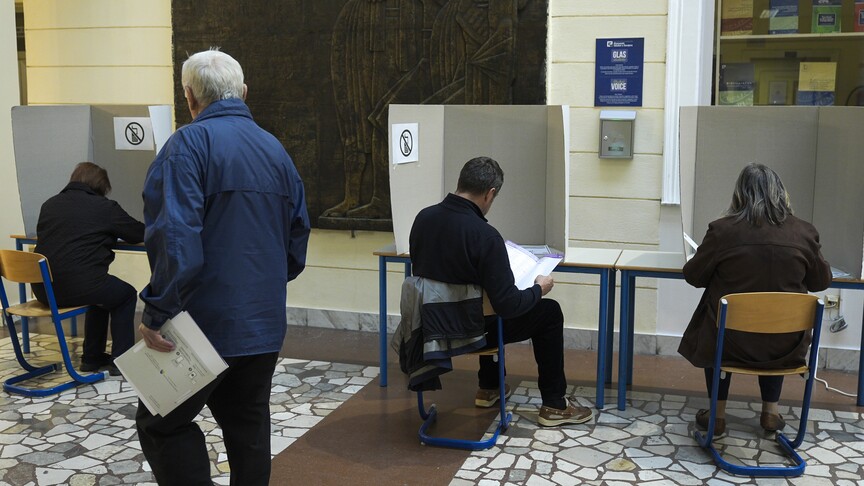
Voters in Bosnia and Herzegovina headed to the polls Sunday to elect the country’s three-member presidency and representatives to a complex network of state, entity and cantonal institutions.
Around 3.4 million people are registered to vote in the general election, with polling stations scheduled to remain open from 7 am to 7 pm local time (0500 to 1700 GMT).
The vote is being held under the power-sharing system created by the Dayton Peace Agreement, which ended the 1992-1995 Bosnian War.
Here is how the electoral system works, who is seeking seats in the presidency and what is at stake.
How is Bosnia and Herzegovina governed?
Bosnia and Herzegovina consists of two largely autonomous entities: the Federation of Bosnia and Herzegovina and Republika Srpska.
The Federation is predominantly populated by Bosniaks and Croats, while Republika Srpska has a predominantly Serb population.
The country also includes the self-governing Brcko District, which formally belongs to both entities but operates under its own administration.
Each entity has its own government, parliament and extensive powers, while institutions at the state level are responsible for areas including foreign affairs, defense and international trade.
How is presidency elected?
Instead of a single president, Bosnia and Herzegovina has a three-member presidency comprising one Bosniak, one Croat and one Serb.
Voters registered in the Federation may vote for either the Bosniak or Croat member, but not both. Voters in Republika Srpska elect the Serb member.
The three members serve four-year terms and take turns chairing the presidency every eight months. Each member therefore serves as chair twice during a full term.
The system is intended to ensure that the three constituent peoples share power at the highest level of the state.
It also restricts voters’ choices according to their place of residence. Serbs living in the Federation cannot vote for the Serb member, while Bosniaks and Croats living in Republika Srpska cannot vote for their respective representatives.
Citizens who do not identify as one of the three constituent peoples are also excluded from standing for the presidency.
Who is running for Bosniak seat?
Denis Becirovic, the incumbent Bosniak member of the presidency, is seeking another term as the candidate of the Social Democratic Party.
Bakir Izetbegovic, leader of the Party of Democratic Action, is seeking to return to the presidency after previously serving two terms and losing to Becirovic in 2022.
Semir Efendic of the Party for Bosnia and Herzegovina and Fahrudin Radoncic of the Union for a Better Future are also contesting the Bosniak seat.
Who is running for Croat seat?
Darijana Filipovic is standing as the candidate of the Croatian Democratic Union of Bosnia and Herzegovina.
She faces Slaven Kovacevic of the Democratic Front and Zdenko Lucic, who is supported by a coalition of five Croat opposition parties.
Who is running for Serb seat?
Zeljka Cvijanovic, the incumbent Serb member of the presidency, is seeking a second term as the candidate of the Alliance of Independent Social Democrats.
Her challengers are Marinko Bozovic of the Serb Democratic Party and Nebojsa Vukanovic of the List for Justice and Order.
What else are voters electing?
The election extends far beyond the presidency.
Voters are choosing members of the 42-seat House of Representatives, the directly elected chamber of the state parliament. Twenty-eight members are elected from the Federation and 14 from Republika Srpska.
The state parliament’s other chamber, the 15-member House of Peoples, is formed indirectly after the election and includes five Bosniak, five Croat and five Serb delegates.
Separate ballots are also being held for the parliaments of the Federation and Republika Srpska.
Voters in Republika Srpska are electing the entity’s president, while those in the Federation are choosing representatives to the assemblies of its 10 cantons.
In total, the election will help determine the composition of governments at the state, entity and cantonal levels.
Preliminary results are expected after polling stations close Sunday evening.