In the biblical story of the Tower of Babel, humanity attempts to build a structure reaching heaven itself, only for the project to collapse under the weight of ambition, power and hubris.
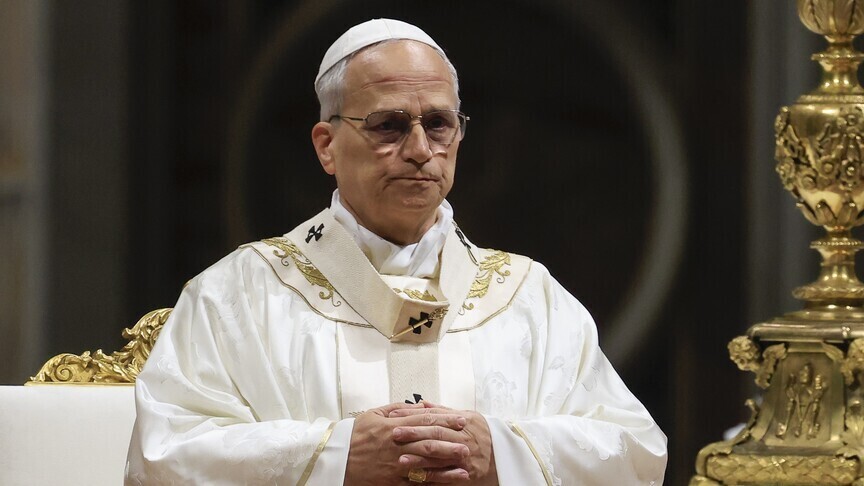
Pope Leo XIV revived that warning in his first major encyclical on artificial intelligence, cautioning that humanity once again stands at a crossroads where technological power risks overtaking moral responsibility.
Invoking the biblical story directly, Pope Leo warned against “the idolatry of profit that sacrifices the weak, a uniformity that neutralizes differences and the pretense that a single language -- even a digital one -- can translate everything, including the mystery of the person, into data and performance.”
The 40,000-word encyclical, Magnifica Humanitas: On Safeguarding the Human Person in the Time of Artificial Intelligence, was more than a warning about AI. It was also seen as a broader challenge to the growing power of Silicon Valley and to the idea that technology alone should determine humanity’s future.
The symbolism surrounding the launch only reinforced that message.
Standing beside the pope during the presentation was Christopher Olah, co-founder of US artificial intelligence company Anthropic, whose appearance drew attention across both technology and religious circles.
The moment highlighted an increasingly unusual convergence of religion, politics and Silicon Valley as AI begins reshaping everything from economies and labor to warfare and personal relationships.
The Vatican says Pope Leo deliberately chose to begin his papacy with an encyclical focused on artificial intelligence because he sees the technology as one of the defining challenges of the modern era.
The pope has repeatedly compared today’s AI revolution to the Industrial Revolution of the 19th century, which transformed labor, wealth and social structures across the world.
His papal name itself reflects that historical parallel.
Leo XIV has said he chose the name in honor of Pope Leo XIII, whose landmark 1891 encyclical Rerum Novarum confronted the social upheaval and inequality unleashed by industrial capitalism. That document became one of the foundations of modern Catholic social teaching, addressing workers’ rights, economic justice and the responsibilities of governments and businesses.
In Magnifica Humanitas, Pope Leo XIV argues that artificial intelligence presents similarly profound questions about human dignity, work, power and inequality.
Throughout the encyclical, he repeatedly warns against “technocratic paradigm” -- the idea that technological progress, efficiency and optimization alone should guide political and economic decisions.
“Technology never remains neutral,” he wrote, arguing that it inevitably reflects the interests and values of those who design, finance and control it.
The pope warned that AI could deepen inequality, concentrate power in the hands of a few companies and governments, spread disinformation and undermine democratic life.
He also strongly criticized the growing integration of AI into warfare.
“There is no algorithm that can make war morally acceptable,” he wrote, while warning against autonomous weapons systems and military uses of artificial intelligence.
The document also places emphasis on labor, with the pope acknowledging that AI may eliminate burdensome work while simultaneously threatening large-scale job displacement and economic instability.
“Humanity -- in all its grandeur and woundedness -- must never be replaced or surpassed,” he wrote. “We can embrace the technological progress that alleviates suffering and unlocks new possibilities, provided that we do not abandon the very essence of our humanity.”
He urges governments, scholars, religious institutions and civil society groups to participate in shaping AI development rather than leaving such decisions solely to private corporations.
“A more moral AI is not enough if that morality is determined by a few,” he warned.
The Vatican’s decision to invite Anthropic rather than OpenAI, Meta, Google or Elon Musk’s xAI was widely viewed as significant.
The company behind the Claude chatbot has attempted to distinguish itself within the AI industry through a stronger public focus on safety and ethics than many competitors.
Anthropic has also drawn public attention through its recent standoff with the US Defense Department after refusing to allow its AI tools to be used for mass surveillance of US citizens or autonomous weapons systems.
Speaking at the Vatican, Olah acknowledged that AI laboratories face incentives that can conflict with ethical decision-making.
“We need informed critics who will tell the labs when we are failing,” he said. “We need moral voices that the incentives cannot bend.”
Olah also warned that the concentration of AI development among a small number of companies and countries could deepen global inequalities, described large-scale labor displacement caused by AI as a “moral imperative of historic proportions” and called the pope’s intervention “profoundly timely.”
He called the event the start of a “long collaboration” and “a powerful illustration of the form this global project of good will might take.”
A Vatican source told CNN that Anthropic’s inclusion was “not an endorsement, prize, reward or canonization.”
Yet analysts say the symbolism was difficult to ignore.
Margaret O’Mara, a historian of technology at the University of Washington, told The Washington Post that the growing overlap between religion, politics and Silicon Valley represented “weird uncharted territory.”
“That’s not something for which we have historic precedent,” she said.
O’Mara also pointed out that Pope Leo XIII’s warnings about industrial capitalism in the 19th century “were not made with the collaboration of any capitalists.”
She also suggested Anthropic may also be making a pragmatic calculation by aligning itself with the Vatican at a time when public distrust toward artificial intelligence companies continues growing.
For years, major technology executives have increasingly described AI in near-religious language, portraying artificial intelligence as the beginning of a transformative new era for humanity.
The Singularity -- a hypothetical event when technology explodes beyond human control -- and the creation of a superintelligence both also come close to religious themes.
“People are so ready to make AGI their god,” Garry Tan, who runs the start-up incubator Y Combinator, told Vanity Fair, referring to artificial general intelligence, a hypothetical AI that surpasses virtually all human cognitive abilities.
Critics say that has put Silicon Valley on a crash course with older religions, especially those that get involved in the AI debate.
Last year, only months into his papacy, Pope Leo warned that AI companies risked “totally ignoring the value of human beings and of humanity” if technological development became detached from moral responsibility, and called on developers to cultivate “moral discernment.”
In response, Marc Andreessen, a venture capitalist and one of Silicon Valley’s driving intellectual forces, mocked the pope on social media.
Later, The Guardian reported that billionaire investor Peter Thiel discussed concerns about the Pope Leo XIV in private lectures about the Antichrist, describing him as a “woke American pope" and lamenting his possible influence on US Vice President JD Vance, a Catholic.
Whether the Vatican can meaningfully influence the trajectory of artificial intelligence remains uncertain.
Yet the Vatican has increasingly sought to position itself as an active participant in global AI governance debates as technology companies continue advancing systems rapidly.
Pope Leo has recently discussed artificial intelligence regulation and ethics with world leaders, including Spanish Prime Minister Pedro Sanchez this week, as governments struggle to respond to the rapid expansion of generative AI technologies.
Analysts say the Church’s intervention carries significance because of its global moral authority and its ability to frame technological questions in ethical rather than purely economic terms.
The Catholic Church represents nearly 1.4 billion people worldwide and remains one of the world’s most influential global institutions.
Just days before unveiling the encyclical, Pope Leo approved the creation of an Interdicasterial Commission on Artificial Intelligence involving representatives from seven Vatican bodies to coordinate future AI-related initiatives and policy discussions.
Anna Rowlands, a theologian at Durham University who appeared alongside the pope during the encyclical’s launch, described the document as an attempt to resist “a culture of mere power” in an interview with CNN.
“This text is a rallying cry,” she said.
news_share_descriptionsubscription_contact