
Anadolu Ajansı © 2026


Germany’s far-right Alternative for Germany (AfD) is riding a surge driven by economic fear rather than migration alone, a prominent expert said after the party’s record win in the eastern state of Saxony-Anhalt.
Peter Matuschek, director of research for pollster Forsa, said surveys indicate Chancellor Friedrich Merz’s Christian Democratic Union (CDU) must rebuild its reputation for delivering prosperity rather than shifting its rhetoric on immigration to lure voters from the AfD.
“It would be a very clear strategy to win over voters on the main issues that people are most concerned about, which is the economy,” he told Anadolu.
“When we ask about the major problems people see in the country, it’s not migration … Migration comes in fourth or fifth place.”
It is the economy, company closures, auto-industry troubles and higher prices that are driving anxiety, he said.
Weekly Forsa tracking shows most Germans are worried about the worsening economic conditions.
AfD supporters are consistently the “most pessimistic” about future prospects even though many are middle class, Matuschek said.
For decades, he noted, the CDU was seen as the party most competent to handle the country’s problems and deliver economic prosperity, with 30%, 40% or even 50% of voters saying so, followed by its coalition partner, the Social Democrats.
“Now we have the CDU at 13%, 14%,” he said.
That confidence, he stressed, will return only through “sound economic policy” that gives people the impression the government can still act on their problems – and through credible figures who can “win over the hearts of voters again.”
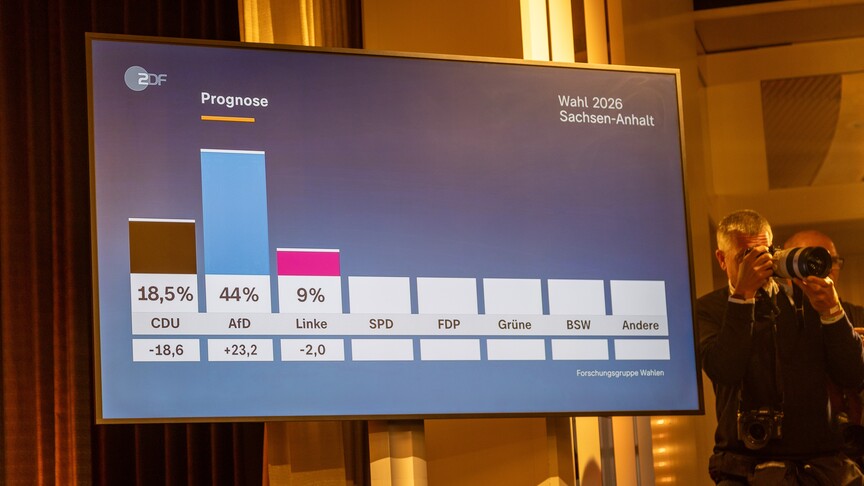
The AfD won a record 43.8% on Sunday and moved closer than ever to taking power in a state for the first time, while CDU slumped to a historic low of 17.2%.
Matuschek called the surge a significant development, but cautioned against reading Saxony-Anhalt as a national trend – or as proof the party could match that level of support in a federal election.
“I think Saxony-Anhalt is not representative of the whole country,” he said, adding that the medium-sized eastern state accounts for only a small share of Germany’s national electorate.
“It is an eastern state with a very special history, a special legacy where the AfD had very good results in the past already.”
AfD scores are generally much higher in the former communist east — often roughly double those in the west — even though the party has also increased its vote share in western Germany in recent elections.
“We have to wait for the upcoming regional elections this month to see whether the Saxony-Anhalt election will have repercussions” on voting behavior, Matuschek said.
“There are many possibilities that might strengthen the AfD in other states, or it might strengthen the other parties, because there might be a backlash.”
Another eastern state, Mecklenburg-Vorpommern, and the city-state of Berlin will elect state parliaments on Sept. 20.
Surveys show the AfD mobilized both its base and former non-voters in Saxony-Anhalt, helping the party more than double its score.
About 170,000 people who stayed home in 2021 went to the polls this time and voted for the AfD, according to a survey by public broadcaster ARD.
Matuschek said Forsa polls show that concerns about the economy and migration were key themes for AfD voters. That fear, he stressed, is about losing what they already have.
“So there are different factors at play, but I think what combines all those issues is this fear and this anger of losing something and of wanting something back, that's to say, going back to the past,” he said, adding that this mood was especially strong in eastern Germany.
“It’s not the poorest who vote for the AfD. We’ve seen this in many, many analyses. It’s a radicalized middle class with fears of losing their status,” Matuschek said.
The Saxony-Anhalt election also highlighted AfD voters’ more favorable view of Russia and their opposition to economic and military support for Ukraine, Matuschek said.
“They believe that if we sought an agreement with Russia and did not support Ukraine, we might get cheaper gas and return to prices as they were before the war,” he said.
Surveys after the vote highlighted how far anger at Merz’s federal record shaped the result.
Public broadcaster ZDF found that 75% of voters in Saxony-Anhalt believe Merz damaged the CDU’s regional performance. Some 88% said if Merz’s government had pursued better policies, the AfD would not have grown so strong in Saxony-Anhalt.
Matuschek said that in several state elections in recent years, regional lead candidates managed to distance themselves from federal politics and their party’s leadership in Berlin.
Saxony-Anhalt’s CDU premier Sven Schulze, he said, failed to persuade voters that the party was addressing economic and regional issues.
Merz on Monday called the outcome his party’s heaviest defeat in years or even decades.
“We are all deeply shocked,” he told reporters in Berlin.
Ruling out a resignation, he said: “Giving up is not an option for me.”
The result fueled media speculation that pressure could grow inside the CDU for Merz to step down, given his historically low approval ratings.
Matuschek said Merz’s personal approval score has already fallen to about 13%, with little sign of a rebound after Sunday.
“This is a loss of confidence we haven’t seen with any chancellor in such a short time,” he said.
Matuschek said Sunday’s result could fuel further infighting among the governing parties in Berlin over the right policy course.
However, he saw little appetite on either side of the coalition for early elections.
That path, he argued, would not help either the CDU or the Social Democrats, given the AfD’s strength in national polls.
Snap elections are “not really an alternative” for either the CDU or the Social Democrats at this moment, he said.
“Because they would lose the majority right away and we would have the AfD as the strongest party in the German parliament. So I assume that neither of them is interested in snap elections.”
With about three years left in the federal term, he said Merz’s coalition wants to remain in office and step up efforts to improve its ratings, while demonstrating that its policies are delivering concrete results and addressing people’s concerns.
However, he noted that the result of upcoming regional elections could further ignite the leadership debate within the Christian Democrats.
news_share_descriptionsubscription_contact