Anadolu staff
17 July 2026•Update: 17 July 2026
- Vikram-1 is designed to carry small satellites into low Earth orbit, where most Earth observation, communications and scientific satellites operate
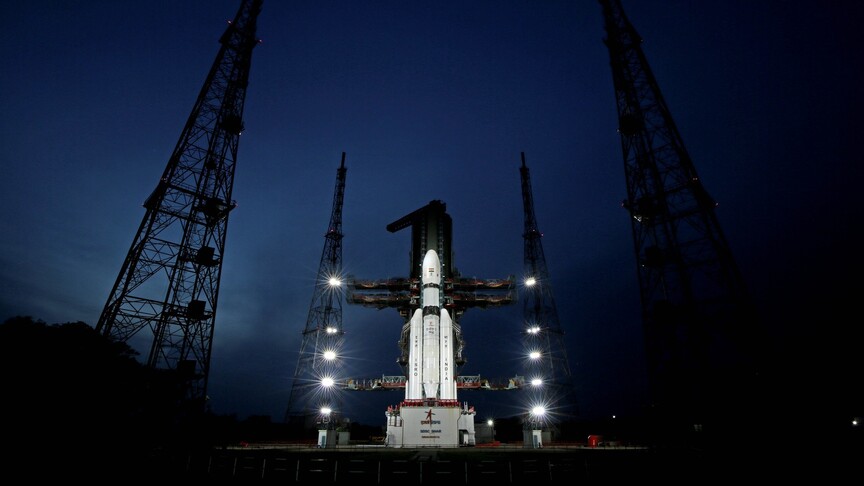
India is set to make its first attempt to place a privately developed rocket into orbit on Saturday, when startup Skyroot Aerospace launches Vikram-1, marking a new phase for the country's commercial space sector.
The launch, scheduled for 11:30 a.m. local time (0600GMT) from the Satish Dhawan Space Centre in the southeastern state of Andhra Pradesh, will test whether the rocket can safely complete all stages of flight and deploy its payload into low Earth orbit.
The mission, named Aagaman -- a Sanskrit word meaning "arrival" -- is the first orbital launch attempt by an Indian private company from Indian soil.
Why is this launch significant?
Named in honor of Vikram Sarabhai, the physicist widely regarded as the father of India’s space program, Vikram-1 is a multi-stage rocket standing roughly 20 meters (66 feet) tall.
India's state-run Indian Space Research Organisation (ISRO) has been launching satellites into orbit for decades using rockets such as the Polar Satellite Launch Vehicle (PSLV), Geosynchronous Satellite Launch Vehicle (GSLV) and LVM3.
An orbital rocket is designed to accelerate a satellite to speeds high enough for it to remain in orbit around Earth, rather than falling back after reaching space.
While sounding rockets and suborbital flights briefly cross the edge of space, orbital launches require significantly higher speeds and are far more technically demanding.
Vikram-1 is designed to carry small satellites into low Earth orbit, where most Earth observation, communications and scientific satellites operate.
Saturday's mission is primarily a demonstration flight aimed at validating the rocket's systems before Skyroot begins commercial operations.
The launch is expected to be streamed live through Skyroot Aerospace's official digital platforms, allowing viewers around the world to follow the countdown and flight in real time.
The Hyderabad-based company was founded in 2018 by former engineers from the ISRO. It first drew international attention in 2022 when it launched Vikram-S, a suborbital rocket that briefly reached space but was not intended to enter orbit.
That flight made Skyroot the first private Indian company to launch a rocket into space, while Vikram-1 aims to accomplish the more difficult task of reaching orbit.
India's broader space ambitions
The mission also reflects broader changes in India's space sector.
For decades, ISRO designed, built and launched the country's rockets while private firms largely supplied components or engineering services.
That began to change after the Indian government introduced reforms in 2020, allowing private companies to build launch vehicles, develop satellites and use government launch facilities under the oversight of the Indian National Space Promotion and Authorization Center, or IN-SPACe.
Those changes have led to the emergence of dozens of space startups seeking to compete in launch services, satellite manufacturing and space technologies.
India has steadily expanded its ambitions in space over the past decade.
In 2023, it became the first country to achieve a soft landing near the Moon's south pole with the Chandrayaan-3 mission. It has also launched the Aditya-L1 solar observatory and is preparing Gaganyaan, its first crewed spaceflight program.
Alongside scientific missions, the government has increasingly sought to grow the country's commercial space industry and attract private investment.
That approach mirrors developments elsewhere, where governments are relying more heavily on commercial companies to provide launch services.
In the US, firms such as SpaceX and Rocket Lab have become major launch providers alongside NASA missions, while Europe and China have also encouraged private launch companies as demand grows for smaller and more frequent satellite launches.
Analysts say the market for launching small satellites has expanded rapidly as governments, universities and private companies deploy constellations for communications, Earth observation and research.
India hopes its lower manufacturing and engineering costs can help domestic firms compete for a share of that business.