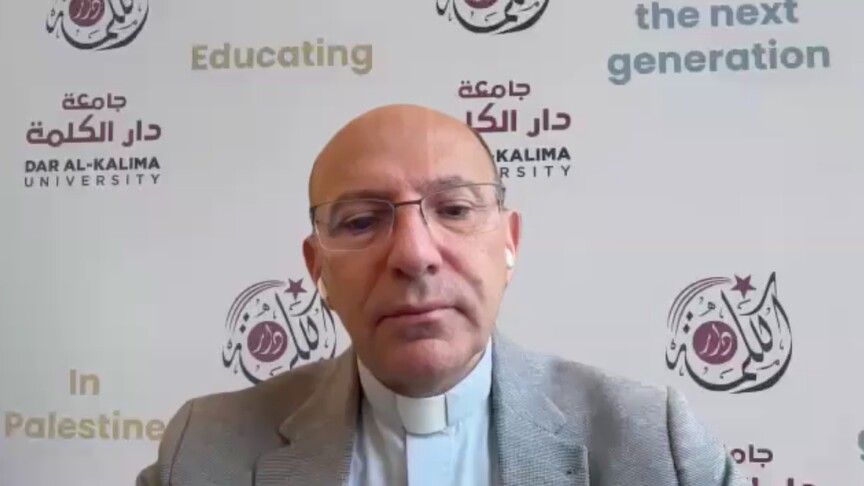
Palestinian Christians are facing an existential crisis under Israeli occupation, with movement restrictions, economic collapse and rising attacks by extremist occupiers pushing families to flee, according to prominent Palestinian pastor and theologian Mitri Raheb.
Raheb warned that if current conditions continue, Christians could disappear from Palestine within decades.
"The situation is deteriorating to an extent that I believe if this will continue, by 2050 there will be no Christians left in Palestine," said Raheb, who is also the founder and president of Dar al-Kalima University in Bethlehem.
Speaking to Anadolu from the occupied West Bank city of Bethlehem, Raheb said daily life under Israeli occupation had become increasingly unbearable for many Palestinian Christians, prompting a growing number of families to emigrate.
"In the last two years, over 200 Christian families from the Bethlehem region have immigrated and left Palestine because they are afraid for their lives, for their kids."
According to Raheb, around 45,000 Christians remain in the occupied West Bank and fewer than 600 in Gaza. Approximately 120,000 Palestinian Christians live inside Israel, alongside around 30,000 other Christians, largely of European or Russian origin.
Raheb said Israel’s expanding network of military checkpoints and road closures has turned movement across the occupied West Bank into “a nightmare” for Palestinians.
“Around Bethlehem, we have 54 checkpoints and gates,” he said. “Through the push of a button, they (Israelis) can close all of these gates, and so we become basically prisoners in our own town.”
He said travel between Palestinian cities has become increasingly difficult, including for professors at his university commuting from Ramallah to Bethlehem – a distance of around 20 kilometers (12 miles).
Because they are barred from crossing through Jerusalem, he said, they are forced to take alternative routes stretching nearly 70 kilometers (43 miles) through multiple checkpoints.
"I don't have even a permit to go to Jerusalem, which is only 10 kilometers away from Bethlehem, and the headquarters of our church is in Jerusalem,” he said.
During Ramadan and Holy Week, he added, both Muslims and Christians were prevented from entering Jerusalem to pray at the Al-Aqsa Mosque and the Church of the Holy Sepulchre.
“European Christians were allowed to enter the church, but the local Christians, the indigenous Christians, were not allowed to do that,” he said.
Raheb said restrictions have also affected clergy and church officials.
He cited the recent case of Cardinal Pierbattista Pizzaballa, the top Catholic figure in Jerusalem, being barred from entering the Church of the Holy Sepulchre to celebrate Palm Sunday Mass.
"As long as Israel can do all of that with impunity, and they are not made accountable, they are not actually sanctioned for it, they will continue to do it,” he said.
Raheb also criticized what he described as a silent and selective international response to attacks on Christian sites.
"Imagine if a synagogue is attacked, the whole world will be up in arms. But when the church in Gaza was targeted, we didn't see really strong voices, not only condemning this, but also asking for accountability."
Since the start of the Gaza war, several churches have come under Israeli attack, including the Church of Saint Porphyrius in Gaza City – one of the world’s oldest churches – where an Israeli strike killed 18 civilians in October 2023. Months later, an Israeli sniper killed a mother and daughter inside Gaza’s only Catholic church, according to local church officials.
Raheb accused Israel’s far-right government of fostering an atmosphere that emboldens attacks against Christians.
“The current Israeli government … is actually giving the umbrella to attack Christians because that is part of their religious ideology,” he said.
He pointed to Israeli National Security Minister Itamar Ben-Gvir’s argument that Israeli Jews spitting at Christians should not be considered a crime.
Raheb said church groups documented more than 62 incidents targeting Christians in Jerusalem this year alone, including clergy being spat at in public.
He described extremist occupiers as “terrorists” seeking to intimidate Christians and force them out of Jerusalem and other areas, citing the recent incident where a Jewish man was filmed pushing over and kicking a French nun in Israeli-occupied East Jerusalem.
He also accused Israeli authorities of pursuing policies aimed at taking over Christian-owned property in Jerusalem’s Old City.
"The Christians in Jerusalem, they own almost 40% of the old city,” he said. “The Israeli would like actually to occupy and to take over these lands and these properties."
Raheb said churches have faced growing financial pressure, including attempts to impose taxes and freeze church bank accounts.
"All of these are ways to intimidate, and to silence, Palestinian Christian voices who dare to speak up,” he said.
Bethlehem’s broader economy, heavily dependent on tourism, has also suffered severe setbacks in recent years.
"Bethlehem lives on tourism, and for the last, maybe five years, there weren't really any tourists coming,” he said. “The economic situation is becoming very difficult."
Raheb said Israeli society has shifted sharply to the right over the past two decades, empowering extremist politicians and occupiers who increasingly target Palestinians, including Christians.
“The peace camp in Israel is no longer there,” he said. “Today, it is the far right in Israel that is in power.”
He argued that the war in Gaza has deepened a sense of impunity among Israeli politicians, soldiers and occupiers.
"Nobody actually will take them to court or even … ask them what they are doing. They have total impunity,” he said. “In fact, these people who murdered Palestinians are celebrated as heroes."
Raheb said the international community’s failure to hold Israel accountable for the Gaza genocide has also emboldened extremist elements within Israeli society.
He also argued that Israel has become increasingly uncomfortable with Palestinian Christians sharing their experiences abroad through church networks in Europe and North America.
"Israel, for over 70 years, had a monopoly over the narrative,” he said.
"Now, Palestinian Christians actually are challenging that narrative and, as Christians, we have access to churches in the Western world, which Israel doesn't like, and this is why I think they want to get rid of us."
Combined with daily restrictions and worsening economic conditions, he said, the current climate has convinced many families to leave.
"Everything becomes so complicated that people think ‘we don't want our kids or grandchildren to grow up in such a militarized zone where our life doesn't count.’”
news_share_descriptionsubscription_contact