Motaz Wanes, Sahin Demir
28 July 2026•Update: 28 July 2026
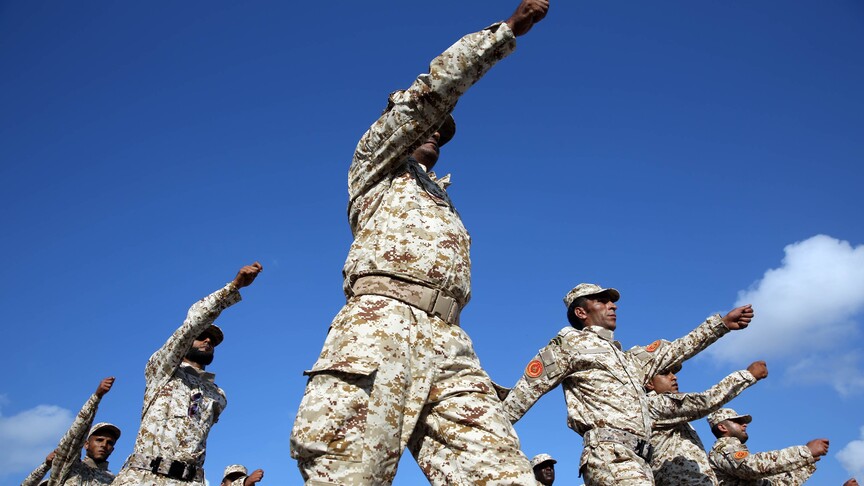
Senior military officials in eastern Libya on Tuesday discussed efforts to unify the country’s armed forces and strengthen defense cooperation with a visiting US congressional delegation.
According to a statement from the eastern-based forces, Deputy Commander Saddam Haftar and Chief of Staff Khaled Haftar met the delegation, headed by Congressman Austin Scott, in the eastern city of Benghazi.
The meeting was also attended by Talal Al-Mihoub, chairman of the parliament’s Defense and National Security Committee, US Congressmen Jimmy Panetta and Salud Carbajal, and US Charge d’Affaires in Libya Jeremy Berndt.
The statement said the discussions focused on enhancing military coordination and supporting efforts to unify Libya’s armed forces to help promote security, stability and peace.
Saddam Haftar said the visit reflected continued US support for military unification efforts, praising cooperation between US Africa Command (AFRICOM) and military leaders in both eastern and western Libya.
He also pointed to the participation of Libyan forces in part of the Flintlock 2026 exercise, hosted in the central city of Sirte in April with troops from more than 30 countries.
According to the statement, the sides agreed that Libya would host the main phase of the Flintlock 2027 exercise.
They also discussed establishing a joint military operations room in Sirte, bringing together personnel from eastern- and western-based forces.
The meeting further addressed plans to establish a unified Libyan air command through cooperation between military leaders on both sides of the country, as well as creating a national air force training center at the Air Academy in the western city of Misrata.
The statement said the initiatives are intended to improve coordination between military units, overcome the country’s military division and lay the groundwork for a unified national army.
Libya’s military remains divided between forces affiliated with the UN-recognized Government of National Unity in the west and forces loyal to eastern commander Khalifa Haftar.
Since 2020, military representatives from both sides have held talks under the UN-sponsored Joint Military Commission (5+5), which includes five officers from each side.
The military split mirrors Libya’s political divide between the Tripoli-based Government of National Unity led by Abdul Hamid Dbeibeh and the eastern-based administration appointed by the House of Representatives in early 2022 and headed by Osama Hammad.
The United Nations has for years been leading efforts to organize national elections aimed at ending Libya’s prolonged transitional period and political and armed conflicts that have persisted since the 2011 overthrow of Muammar Gaddafi.