- Most countries refrain from recognizing Jerusalem as Israel’s capital, citing city's contested status
- Jerusalem’s status remains a key unresolved issue in Israeli-Palestinian conflict
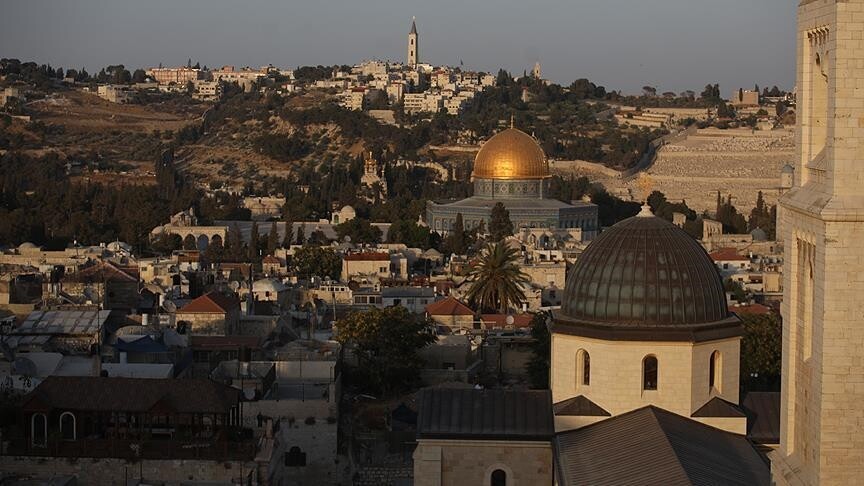
Argentina is set to become the eighth country to relocate its embassy to Jerusalem after President Javier Milei vowed during a visit to Israel that the move would take place “as soon as conditions allow.”
Milei arrived in Israel on Sunday for his third official visit since taking office in December 2023. He first announced plans to relocate the embassy from Tel Aviv during a visit in February 2024 and reaffirmed the decision in June 2025 during a speech at the Israeli parliament, saying the move would be carried out in 2026.
Jerusalem remains at the heart of the Israeli-Palestinian conflict and is widely regarded as one of its most sensitive issues.
While Israel claims the entire city as its capital, Palestinians view East Jerusalem – occupied by Israel since 1967 – as the capital of a future Palestinian state, in line with longstanding international consensus and UN resolutions.
Israel occupied East Jerusalem in the 1967 Arab-Israeli war and later annexed it in 1980 in a move not recognized by the international community. The UN Security Council rejected the annexation and, in Resolution 478, called on countries to withdraw their diplomatic missions from Jerusalem, reinforcing the position that the city’s final status should be resolved through negotiations rather than unilateral measures.
Despite Israel’s insistence that Jerusalem is its “undivided capital,” the overwhelming majority of foreign missions remain in Tel Aviv or its suburbs, reflecting reluctance to recognize Israeli sovereignty claims over a city whose eastern sector is considered occupied territory under international law.
Even so, several countries have moved their embassies to Jerusalem. Below is a chronological list:
United States
The US recognized Jerusalem as Israel’s capital on Dec. 6, 2017 during Donald Trump’s first term, marking a departure from longstanding US policy on the city’s status.
It relocated its embassy from Tel Aviv to Jerusalem on May 14, 2018, coinciding with the 70th anniversary of Israel’s founding.
The opening came amid protests along the Gaza border. On May 14, Israeli forces killed around 60 Palestinians during clashes.
In 1995, the US adopted the Jerusalem Embassy Act, setting a May 31, 1999 deadline for relocating the embassy to Jerusalem. Successive presidents, however, waived the requirement every six months, citing concerns over the Israeli-Palestinian peace process and broader US interests.
Guatemala
Guatemala relocated its embassy to Jerusalem on May 16, 2018, just two days after the US, becoming the second country to do so following Washington’s move.
Paraguay
Paraguay inaugurated its embassy in Jerusalem on May 21, 2018, under then-President Horacio Cartes, becoming the third country to do so.
The move was reversed on Sept. 5, 2018, after newly inaugurated President Mario Abdo Benitez ordered the embassy returned to Tel Aviv, citing a desire to support a neutral stance and contribute to Middle East peace efforts.
The country reinstated its embassy in Jerusalem on Dec. 12, 2024, under President Santiago Pena.
Kosovo
Kosovo opened its embassy in Jerusalem on March 14, 2021, becoming the first European country and Muslim-majority territory to do so.
The move followed a commitment made under a US-brokered normalization agreement with Serbia signed in September 2020, under which Kosovo pledged to establish diplomatic relations with Israel.
The EU expressed regret over the decision, saying it diverged from the bloc’s position on Jerusalem.
Honduras
Honduras officially inaugurated its embassy in Jerusalem on June 24, 2021, under President Juan Orlando Hernandez.
The move followed earlier steps to deepen ties with Israel, including the opening of a trade office in Jerusalem in 2019, which was later upgraded to full embassy status.
Papua New Guinea
Papua New Guinea opened its embassy in Jerusalem on Sept. 5, 2023, with Prime Minister James Marape attending the inauguration ceremony.
Marape described the move as a “conscious choice,” saying that recognizing Jerusalem as Israel’s capital was tied to the country’s Christian identity, according to Israeli media.
"For us to call ourselves Christians, paying respect to God will not be complete without recognizing that Jerusalem is the universal capital of the people and nation of Israel,” he said.
Fiji
Most recently, Fiji’s Prime Minister Sitiveni Rabuka on Sept. 17, 2025 opened his country’s new embassy in Jerusalem, with Israeli Prime Minister Benjamin Netanyahu and Foreign Minister Gideon Saar in attendance.
Writing on the US social media platform X, Saar hailed Fiji’s move as a “historic decision,” calling Jerusalem “the eternal capital” of Israel.
Reluctance among majority of countries
Despite a handful of countries relocating their embassies to Jerusalem, the vast majority of states with diplomatic ties to Israel have refrained from taking similar steps, citing the city’s contested status and its implications for the Israeli-Palestinian conflict.
Public diplomatic listings show Israel hosts 96 resident embassies, with 89 in the Tel Aviv District and seven in Jerusalem. If Argentina proceeds with the move, the number in Jerusalem would rise to eight.
Israel has diplomatic relations with more than 160 countries.
At the same time, diplomatic momentum has increasingly moved in the opposite direction, with support for Palestinian statehood expanding.
In 2024, Spain, Ireland, Norway and Slovenia moved to recognize Palestine. In 2025, several countries followed, including Mexico, the UK, Canada, Australia, Portugal, France, Luxembourg, Malta and Belgium.
As of September 2025, 157 of the UN’s 193 member states, representing 81% of the international community, recognize the State of Palestine.