- 'Many are not going to be able to manage this for very long,' he tells Anadolu
- Over 130 healthcare facilities hit since March, deepening humanitarian strain
Lebanon is facing a “catastrophic” humanitarian crisis that is pushing the country beyond its limits amid ongoing Israeli attacks, a senior United Nations official warned.
"This is one step too far," Imran Riza, the UN resident and humanitarian coordinator for Lebanon, told Anadolu.
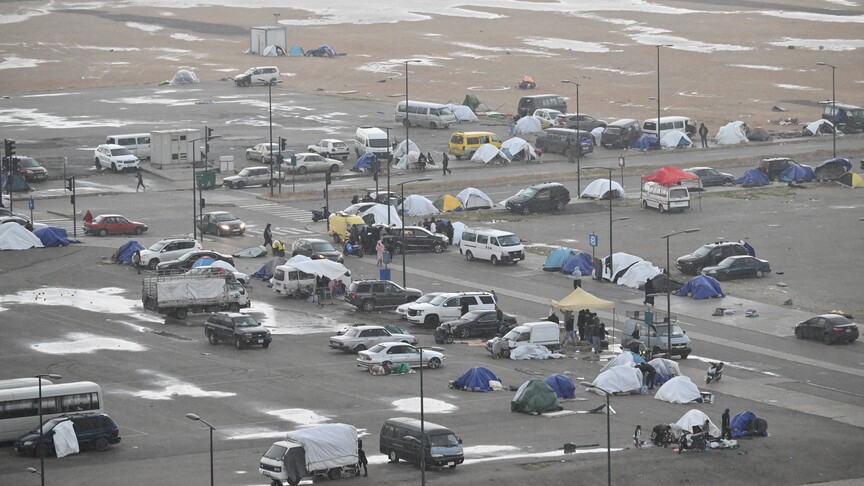
He said more than 1.2 million people – over 20% of the Lebanese population – have been displaced since March 2, when Israel’s attacks on Lebanon began in response to Hezbollah’s cross border strikes.
Riza said that the scale and repetition of displacement, combined with years of economic collapse and instability, have left people with “very little ability to sustain themselves,” pushing an already fragile nation to the brink.
Describing the situation as an “enormous and huge humanitarian crisis,” he said it is testing people’s sense of the future.
Israel has killed at least 2,124 people and injured nearly 7,000 in Lebanon since the latest offensive began, according to Lebanon’s Health Ministry.
Second displacement, deeper despair
The latest escalation between Hezbollah and Israel has uprooted families already affected by previous conflict.
“For many of them, for most of them, this is the second displacement in a year and a half," said Riza.
He noted that during the 2024 war, more than one million people were displaced. While most returned, around 65,000 were unable to go back to destroyed villages.
Of the 1.2 million currently displaced, around one million are not in shelters, Riza said.
“They are with host communities. They are with family members. They are renting in different places. They are staying in other places where they have found something.”
Around 140,000 to 145,000 are in “collective shelters,” including public schools, the Lebanese University and vocational training centers.
However, he warned that coping mechanisms are rapidly breaking down.
“Many are not going to be able to manage this for very long,” he said.
Riza noted that since 2019, Lebanon has faced a financial collapse, the COVID-19 pandemic and the Beirut port explosion.
In 2023, tensions flared between Israel and Hezbollah, with the conflict escalating in 2024 with major Israel strikes, a ground invasion and the pager explosions. A ceasefire was signed in November 2024.
“We always spoke a great deal about Lebanese resilience,” he said. “But there is a limit after you see all of these crises one upon the other. Right now, this is particularly brutal.”
Civilians, infrastructure under fire
The humanitarian toll continues to mount, with civilians bearing the brunt of the violence.
Riza pointed to Israeli strikes in Beirut on April 8 that killed more than 300 civilians, including women and children, in a single day.
“There is a huge civilian cost,” he said. “You keep hearing about entire families being impacted.”
He added that, as in 2024, civilian infrastructure such as bridges has been targeted.
Healthcare systems are also under severe strain.
According to UN data, there have been 133 attacks on healthcare facilities since early March, forcing hospitals to shut down and overwhelming those still operating.
At least 87 healthcare workers have been killed in Israeli strikes.
He said rebuilding the health system will take time, noting that the World Bank is assessing damage and losses.
“We never got to the recovery reconstruction phase in the 15 months that passed after the last cessation of hostilities,” he said. “We’re in a pretty grim situation at this time.”
For many, uncertainty remains overwhelming – not only about when they can return, but whether their homes still exist.
“If their houses are not there, what do they go back to?” he asked.
Aid response crippled
Despite soaring needs, humanitarian agencies say they are unable to respond adequately due to severe funding shortfalls.
Lebanon is “in a much worse place than it was years ago,” Riza said, adding that institutions have weakened and lack resources.
Most of the UN agencies and NGOs that have traditionally responded to crises have seen their budgets, staffing and capacity slashed over the last year and a half.
“We are not in a position that we can really respond in the way that we would have been able to do a couple of years ago.”
Unlike in 2024, when Gulf and European countries mobilized significant aid, current efforts have been limited amid wider regional crises. Jordan has proposed a land bridge for aid delivery.
Lebanon, he said, has “fallen off the radar.”
He highlighted urgent needs including medical supplies, trauma kits, food and cash assistance.
“Food supplies are very limited, and of course everything is becoming extremely expensive,” he said.
Water infrastructure has also been heavily damaged in conflict-hit areas, he said.
Access remains a major challenge, particularly in southern Lebanon, where an estimated 106,000 to 110,000 people remain amid the hostilities.
“We are trying to find ways of accessing them,” he said, “but it is quite complicated both because of the destruction on the ground and the ongoing hostilities.”
He urged all parties involved in the conflict to respect the UN’s right to access those in need.
Ceasefire and respect for international law
Riza said humanitarian workers, medical staff and journalists are increasingly being affected by the violence.
“We’ve had humanitarian workers killed … we had a Lebanese Red Cross colleague who was killed, and another one injured ... We have had journalists killed again,” he said.
“These are huge breaches of international humanitarian law,” he added.
He said many local UN staff are among the displaced but continue to work.
“Many of them are themselves displaced. Their families are displaced. Many are hosting relatives from their villages in their houses here in Beirut.”
Riza called for an immediate end to the violence and respect for international law.
“If you were to ask any Lebanese today, the first thing they would ask for is a cessation of the hostilities, of a ceasefire, peace,” he said.
"The most they want is to be able to go back to their homes and to resume their livelihoods and make sure that their children are going to school and getting education."