Rasa Evrensel
22 May 2026•Update: 22 May 2026
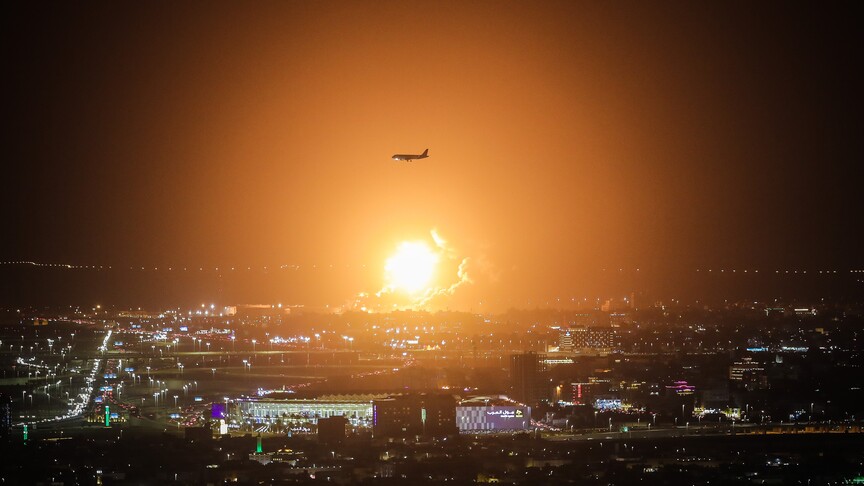
Iraq’s investigation committee probing attacks targeting Saudi Arabia and the United Arab Emirates will analyze data and evidence in cooperation with both countries, a military spokesman said Friday.
Speaking to the Iraqi News Agency (INA), Sabah al-Numan, spokesperson for the commander-in-chief of the armed forces, said the special committee investigating the attacks on Saudi Arabia and the UAE is continuing its work and that there are no rushed deadlines for announcing the results.
“The special committee investigating the attacks on Saudi Arabia and the UAE is a high-level committee with a specialized intelligence and technical character. Its field mission is to analyze and compare data, forensic evidence, and radar data in direct cooperation with our brothers in Riyadh and Abu Dhabi,” al-Numan said.
He stressed that the security of neighboring countries is a red line and said restricting weapons to state control remains a necessary security strategy.
“Restricting weapons to the state control is not a political slogan, but rather a security strategy that must be implemented,” he said.
Al-Numan added that the Iraqi state would not tolerate actions contradicting its sovereign decisions.
“The state will not allow any positions that contradict its sovereign decision, and anyone proven to be involved will bear the full legal and military consequences in accordance with the Counter-Terrorism Law and applicable military laws,” he added.
The remarks came after the UAE said Sunday that a drone strike originating from Iraqi territory caused a fire in a generator outside the perimeter of the Barakah Nuclear Power Plant.
Saudi Arabia also said its air defenses intercepted and destroyed three drones that entered Saudi airspace from Iraq.
Regional tensions have remained high since the US and Israel launched strikes against Iran in February, prompting retaliatory attacks by Tehran against Israel and US allies in the Gulf, along with the closure of the Strait of Hormuz.
A ceasefire took effect on April 8 through Pakistani mediation, but talks in Islamabad failed to produce a lasting agreement.
US President Donald Trump later extended the truce indefinitely while maintaining a blockade on vessels traveling to or from Iranian ports through the Strait of Hormuz.