Muhammed Yasin Güngör
24 September 2026•Update: 24 September 2026
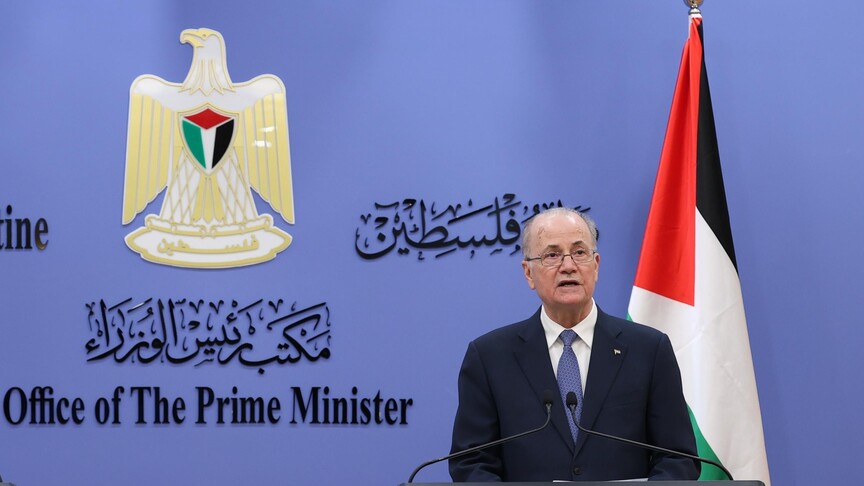
Palestinian Prime Minister Mohammed Mustafa said Thursday that growing diplomatic recognition of the State of Palestine must yield concrete political protection and economic stability, urging international partners to move beyond symbolic gestures.
"The growing recognition of the State of Palestine represents an important political development, but recognition should also translate into practical results," Mustafa told foreign ministers gathered in New York for the High-Level Ministerial Global Alliance for the Implementation of the Two-State Solution.
Mustafa maintained that formal acknowledgment should drive tangible steps, including accession to international financial institutions and full membership in the UN, as he urged remaining countries to recognize Palestinian sovereignty without delay.
Shift toward state realization, ground crises
Outlining a fundamental policy transition, Mustafa urged the alliance to concentrate on strategic priorities to enable actual governance.
"Today, we need to move from state building to state realization," said Mustafa, explaining that strong public institutions must possess a clear mandate to exercise sovereignty for the Palestinian people.
He warned that Israeli occupation plans in the strategic E1 sector are cutting off East Jerusalem and "eroding the human and territorial foundations of the two-state solution."
Financially, Mustafa revealed that his administration faces an unsustainable monthly funding gap of $200 million due to withheld clearance revenues, while joblessness has reached 50% nationally and nearly 78% in Gaza.
Reconstruction parameters, humanitarian challenges
Nickolay Mladenov, the High Representative for Gaza for the US-led Board of Peace, announced a $2.45 billion early recovery package spanning 66 immediate projects administered by the National Committee for the Administration of Gaza (NCAG).
"Reconstruction is not an alternative to a political settlement," Mladenov cautioned, emphasizing that rebuilding the enclave without self-determination would construct "a more comfortable confinement."
Mladenov stressed that reconstruction remains conditioned on ground security and arms decommissioning, while acknowledging that humanitarian entry remains severely constrained and Palestinian casualties persist.
UN Assistant Secretary-General Ramiz Alakbarov highlighted dire field conditions, warning that southern communities living below sea level face severe winter flooding from untreated sewage and domestic waste. Alakbarov urged lifting dual-use import restrictions that obstruct humanitarian relief, and encouraged unified governance in Gaza and the West Bank under the Palestinian Authority.
Regional unity, European backing
Saudi Foreign Minister Prince Faisal bin Farhan insisted that Gaza must not emerge from the conflict politically or territorially divided from the West Bank and East Jerusalem.
"We cannot assume that the basis of this solution, the two-state solution, will persist," he warned, asserting that expulsions and unilateral facts on the ground actively dismantle future viability.
"Every day, every delay has a price. So, the question is, how many people must die to turn this vision into a reality?" he asked.
Norwegian Foreign Minister Espen Barth Eide said Oslo's formal recognition of Palestine permanently removed a bilateral veto that had stalled progress since the Oslo Accords. Eide affirmed that Norway recently expanded direct budget assistance to keep Palestinian institutions viable, while enforcing trade bans on goods originating from the Israeli occupation in line with International Court of Justice rulings.
European Union Foreign Policy Chief Kaja Kallas acknowledged that diplomatic declarations remain sharply "at odds with the hard realities on the ground."
Kallas reaffirmed the EU’s support for upcoming Palestinian legislative elections, noting that Brussels is deploying environmental pilot projects under its Team Gaza initiative, while backing demilitarization frameworks and full Israeli military withdrawal.