Beril Canakci and Rabia Ali
18 May 2026•Update: 18 May 2026
- 'We are blue-collar workers, civilians, medical aid professionals, just trying to bring food, medicine to people who have been under blockade for past 17 years,' says activist Meagan Marie Dominguez
- 'Regime of Israel is pretending to be above all sorts of international laws and conscience and committing their crimes in plain sight,' Spanish activist Javi Aparente tells Anandolu
As Israeli naval forces attacked several vessels from the Global Sumud Flotilla en route to Gaza, activists said they would continue their humanitarian mission despite ongoing detentions at sea.
"We could last another day, we could last another hour, we don't know yet, but we're going to keep going until they stop us," Irish activist Mikey Cullen, a poet and teacher from Dublin, told Anadolu from aboard one of the vessels.
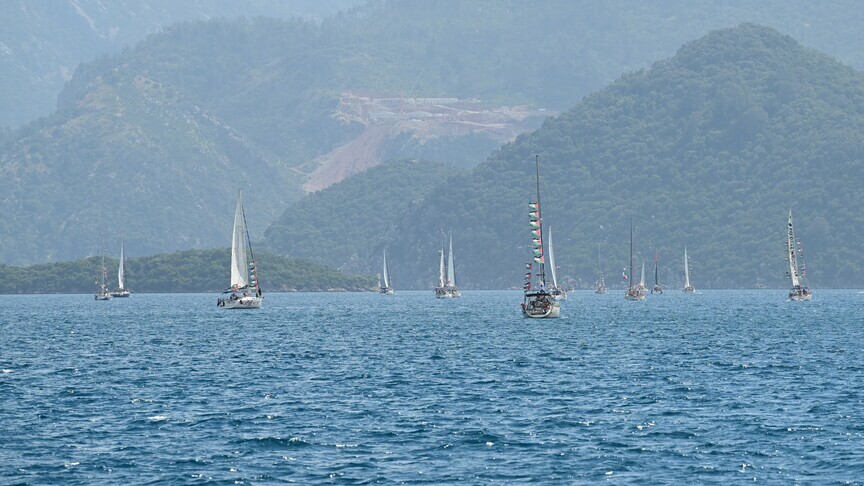
Originally departing from Barcelona on April 12 before joining additional vessels across the Mediterranean, the Gaza-bound aid flotilla had most recently set sail from the Turkish port of Marmaris on Thursday with 54 vessels.
On Monday morning, Israeli naval warships intervened in 16 vessels from the convoy, some 250 nautical miles from the enclave, organizers said.
Cullen said he was awakened to reports that several vessels at the front of the convoy had already been intercepted by Israeli forces.
"When I went out on deck, I could see the Israeli warship and a large cargo ship looking vessel which turned out to be their prison ship was over to my right about 500 meters (1,640 feet) away and we could see speed boats further in the distance."
The activist said that they had fled south, as did a number of other boats.
He added that the flotilla was still attempting to proceed toward Gaza, even as some boats came under pressure from Israeli naval forces.
"My boat is currently evading the IDF (Israeli army), they are chasing us but one of their prison boats is maybe a kilometer or two behind us on the horizon. We are heading south towards Gaza."
Cullen described the interception as unlawful and said that Israel was violating international norms at sea.
"It just shows Israel's disrespect and just wanton violation of international law of any international order and the disrespect to the sovereignty of European countries that they come into Europe and kidnap European citizens out of European waters."
In late April, Israeli forces attacked more than 20 vessels from the Global Sumud Flotilla off Crete, detaining around 180 activists. Two activists — Thiago Avila and Saif Abu Keshek — were later transferred to Israel for questioning before being released and deported after several days in detention.
Israel committing crimes in plain sight
Spanish activist Javi Aparente told Anadolu that the interception had unfolded across multiple vessels in international waters.
“A little over three hours ago, the Israeli occupation forces started illegally boarding and abducting the Global Flotilla humanitarian mission on its way to Gaza carrying only civilians and humanitarian aid.”
He said that Israeli forces were acting with impunity and disregard for international law.
"Once again, the regime of Israel is pretending to be above all sorts of international laws and conscience and committing their crimes in plain sight because they know that the level of impunity that they have achieved is at the It's at the top level."
Aparente said that 10-12 boats had been intercepted already and more fast rigid inflatable boats were approaching other boats and taking them to vessels very similar to the ones that had intercepted them earlier.
'This is not going to be end of it'
Meagan Marie Dominguez, an American activist on board the Kasr-i Sadabat vessel, reiterated that the flotilla was a civilian-led humanitarian mission.
"We are blue-collar workers, civilians, medical aid professionals, just trying to bring food, medicine, baby formula, diapers to people who've been under a blockade for the past 17 years. This is not a military action. This is not anything illegal."
She told Anadolu that the mission was protected under international humanitarian law, calling the interception “a complete crime against humanity.”
"When food and medicine has become a crime, the world needs to check in with itself, and we need to see what we can do better as humans on this entire planet. We are all responsible for each other."