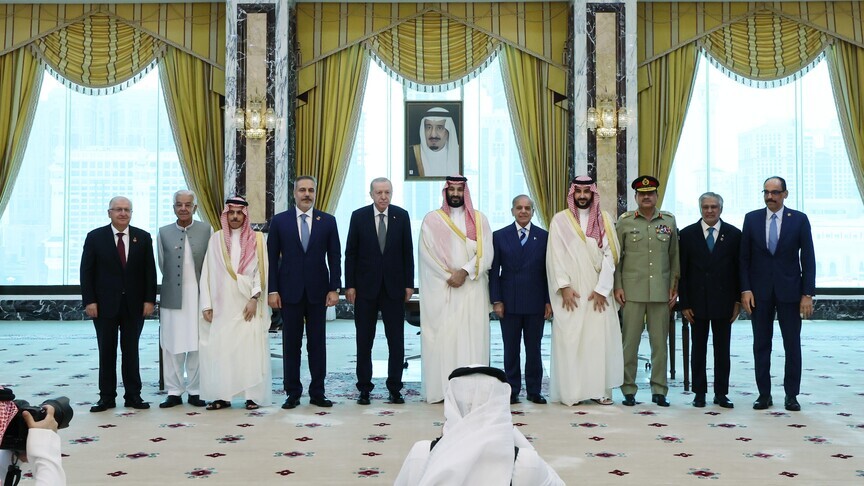
The joint defense agreement signed by Saudi Arabia, Türkiye, and Pakistan in Mecca on Aug. 7 has the potential to move relations among the three countries beyond traditional cooperation and political coordination. Under the framework, an armed attack on one party would be considered an attack on all three, while defense cooperation would be strengthened.
This should not be seen merely as a symbolic statement. If developed institutionally, the agreement will enhance regional deterrence and help these countries protect their security by relying on their own capacities, rather than leaving it solely to external guarantees and shifting international dynamics.
The choice of Mecca as the signing venue gives the agreement a significance that goes beyond the purely military dimension. Mecca is the shared spiritual center of the Islamic world. This symbolism, however, should not lead to hasty conclusions. It would be premature to label the pact a full-fledged "Islamic NATO" from day one. The true strength of any alliance depends less on the wording of its texts and more on the clarity of its obligations, the speed of decision-making, joint command and control capabilities, shared training and standards, and the actual ability to mobilize in a crisis.
Nevertheless, this agreement establishes a robust core with room to grow. The complementary capabilities of the three nations are particularly striking. Saudi Arabia serves as a powerful hub, drawing on its religious and political influence, energy resources, investment capacity, ports in the Red Sea and Persian Gulf, and its position at the crossroads of Asia, Africa, and Europe. Türkiye forms the natural western flank of this structure, bringing its large and experienced armed forces, advanced defense industry, and geographical access to the Mediterranean, the Black Sea, and Europe. Pakistan, in turn, adds critical strategic weight with its vast human resources, military experience, defense industry, and nuclear capabilities.
It must be explicitly stated, however, that Pakistan's possession of a nuclear arsenal does not automatically translate into a shared nuclear umbrella under this agreement. The publicly released text contains no such commitment. Robust deterrence stems not from ambiguity, but from clear political will and tangible capabilities.
The real opportunity lies in these three nations underpinning their military strength with economic and technological integration. Defense cooperation must extend beyond mere arms procurement and joint exercises. Instead, the focus should be on joint research and development, defense production, technology transfer, aligning supply chains, and cultivating highly skilled human capital. This approach not only reduces costs and scales up domestic production but also elevates these countries from being mere consumers of imported systems.
Security and the economy cannot be separated from one another. While militaries secure trade routes, it is trade, industry, and investment that generate the wealth necessary to finance and sustain that security. Consequently, the Mecca Agreement should be viewed not merely as a joint defense pact but as the security architecture for a broader economic corridor.
Türkiye represents the pivotal link in this corridor. Far from being a mere transit state between Asia and Europe, it is a strategic hub connecting the Mediterranean, Black Sea, Caucasus, Central Asia, and European markets. When Saudi Arabia's port, logistics, and investment capabilities are combined with Pakistan's Arabian Sea outlets and South Asian connectivity – and anchored by Türkiye's access to Europe – the result could be far more than a single transit route. Instead, it has the potential to forge a highly adaptable network made up of maritime, rail, road, energy, and digital infrastructure.
Freight originating from Pakistan's ports of Karachi and Gwadar could be shipped to Saudi ports in the Gulf or the Red Sea. Leveraging Saudi Arabia's expanding rail, road, and logistics infrastructure, these goods could then transit through Jordan and Syria, ultimately reaching Türkiye and European markets. This network would not need to compete with the China-Pakistan Economic Corridor (CPEC) or China’s Belt and Road Initiative (BRI). Instead, it could serve as a complementary framework that allows regional actors to retain strategic autonomy, safeguard their security interests, and maximize their economic returns.
This approach would also mitigate the risks of overreliance on a single overland route. While the Istanbul-Tehran-Islamabad railway is a vital link in theory, infrastructure gaps, operational hurdles, regulatory mismatches, and political uncertainties have kept it from becoming a reliable trade corridor. A multimodal alternative developed under the Mecca Agreement would cement connectivity between Pakistan and Türkiye, ensuring it is no longer held hostage to a single transit country or bottleneck.
Jordan and Syria are pivotal to the overland connectivity of this initiative. Jordan links northern Saudi Arabia to the Levant, while Syria serves as the natural bridge to Türkiye and the Eastern Mediterranean. Achieving stability in Syria, strengthening its sovereign institutions, and launching a genuine reconstruction process would unlock economic opportunities not only for the Syrian people but for the broader region. Furthermore, embedding Jordan more deeply into regional transit, energy, and investment grids would act as a cornerstone of regional stability.
In this context, the concept of the historic Hejaz Railway must be reimagined for the 21st century. The objective is not a nostalgic revival of the old route, but rather the construction of a modern equivalent to the historic corridor stretching from Istanbul through Damascus and Amman to the Hejaz. This upgraded architecture would consist of high-capacity railways, modern highways, logistics hubs, power transmission lines, and fiber-optic data cables. Beyond facilitating the seamless movement of goods and people, such an integrated network would catalyze regional manufacturing, tourism, and cross-border investment.
Similarly, the historical TAPLINE (Trans-Arabian Pipeline) corridor warrants a strategic reappraisal. While reopening the antiquated oil pipeline is impractical due to immense engineering, environmental, financial, and security hurdles, its historical right-of-way can be reimagined. It could be transformed into a modern, multi-use transit corridor accommodating new oil, natural gas, or hydrogen pipelines, alongside power grids, fiber-optic networks, railways, and highways. This would provide Saudi Arabia with an additional gateway to the Mediterranean, generate transit revenues for Jordan, Syria, and Lebanon, and act as a catalyst for industrial and logistics investments.
Crucially, this vision should not aim to forge an exclusionary bloc or breed new dependencies. Türkiye is a NATO ally deeply integrated into both Eastern and Western economies. Saudi Arabia cultivates robust partnerships with the United States, Europe, China, India, and other global players. Pakistan likewise pursues a multi-vector foreign policy, balancing ties with China, the Gulf states, the US, and South Asia. Ultimately, the strategic merit of the Mecca Agreement is not that it forces a binary choice between East and West. Rather, it empowers these nations to engage with the international community from a position of greater balance and formidable strength.
To ensure its longevity, the agreement must be anchored by concrete institutions and operational mechanisms: a regularly convening supreme defense council, a joint risk assessment and early warning center; comprehensive exercises across air, missile, naval, and cyber domains; and collaborative defense production programs. Beyond the military sphere, it necessitates an investment fund to underwrite infrastructure projects, streamlined frameworks for trade, customs, capital flows, and skilled labor mobility, and a definitive timeline for interconnecting regional ports, railways, energy grids, and data networks.
History demonstrates that military alliances forged solely in response to transient threats rarely stand the test of time. In contrast, partnerships that anchor defense cooperation in shared economic dividends, industrial integration, technological advancement, and mutual public interests are inherently more resilient.
Herein lies the ultimate promise of the Mecca Agreement. If Türkiye, Saudi Arabia, and Pakistan can transition from being reactive actors to proactive architects of shared institutions, transit corridors, and industrial capacity, a new regional order could take shape. This would not be an exclusionary bloc aligned against the world, but an open, productive, and robust framework – one fully capable of protecting their sovereign interests while anchoring long-term regional peace.
*Opinions expressed in this article are the author's own and do not necessarily reflect the editorial policy of Anadolu.
news_share_descriptionsubscription_contact