
Anadolu Ajansı © 2026


- Abdullah Eren is the President of the Turkish Cooperation and Coordination Agency (TİKA).
In the literature of post-development theory, a recurring argument holds that the international aid system is structurally incapable of the transformation it promises. This is because its operating logic—built on conditionality as the price of assistance, technical knowledge as a Northern monopoly, and accountability flowing upward to donors rather than downward to communities—structurally reinstates the hierarchies it is commissioned to dissolve.
For decades, this remained a dissenting scholarly perspective. In 2025, this top-down architecture of development aid had significant global political repercussions, as evidenced by the dismantling of USAID. The dismantling of USAID, with 5,800 of 6,200 contracts canceled and $60 billion withdrawn, did not resolve the theoretical debate. Neither did the fact that, for the first time in thirty years, the United States, the United Kingdom, France, and Germany cut aid simultaneously. Instead, these systemic failures rendered the debate urgent.
With the OECD projecting a further 28 percent decline in official development assistance by 2026, and Rasella et al. (2026) estimating at least 9.4 million excess deaths by 2030 under current defunding trajectories, the scale of the crisis has moved beyond theoretical speculation and into material reality. It is a matter of political fact. The international aid architecture is not being reformed; it is retreating. And in that retreat lies, paradoxically, a genuine structural opportunity to build something different.
The opportunity created by this retreat is not a funding gap to be filled. It is a paradigmatic space to be reimagined, and waste management emerges as a particularly promising domain through which alternative development models may be advanced. The numbers are instructive. Municipal solid waste will grow from 2.1 billion tons today to 3.8 billion tons by 2050, with the steepest increases concentrated in the Global South. A business-as-usual approach is projected to cost $640.3 billion annually by mid-century. A full transition to circular economy principles, according to the UNEP's Global Waste Management Outlook (2024), would not merely contain that cost; it would reverse it, generating a net annual gain of $108.5 billion. The implication is structural, not technical: waste is not a development problem but a development opportunity.
Zero waste, properly understood, inverts the extractive logic that post-development scholars have long identified at the heart of the development apparatus. Where conventional development begins with a deficit—namely, what communities lack, what must be transferred, and what expertise must be imported—zero waste begins with what already exists and is already being mismanaged. This inversion is not merely conceptual; it is institutional.
The circular economy, as modeled in Employment in the Circular Economy: Leveraging Circularity to Create Decent Work (ILO, Circle Economy, and World Bank, 2025), already employs between 121 and 142 million people worldwide (5 to 5.8 percent of global employment outside agriculture), with more than 74 million of those workers operating in the informal economy. Circularity, in other words, is not an aspiration. It is already a labor market reality, one that existing development frameworks have been slow to recognize.
What such a reorientation requires is not a new funding mechanism but a different unit of analysis. Conventional development cooperation measures outputs: contracts signed, facilities constructed, and training sessions completed. A zero-waste framework measures something harder to quantify and more consequential: the degree to which communities have acquired productive capacity rather than received finished solutions.
The distinction is not rhetorical. AidData's Listening to Leaders survey (2025), drawing on a decade of data from 148 countries, finds that Türkiye has emerged as one of the few development partners whose footprint is expanding as traditional bilateral actors contract, working with leaders across 58 countries by 2024. The report identifies non-conditionality, technical grounding, and locally embedded cooperation as the defining characteristics of partners that leaders in recipient countries increasingly prefer. This is not a coincidence. It is a structural signal about what the next architecture of development cooperation will need to look like.
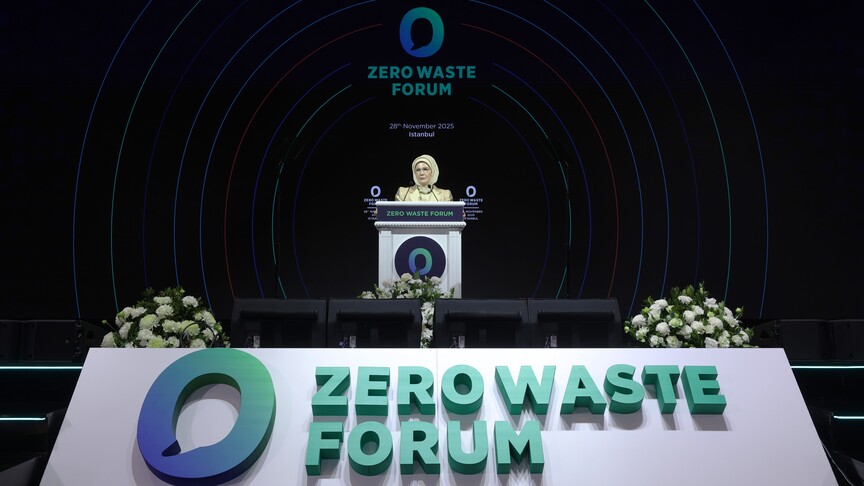
Türkiye's zero waste initiative, launched in 2017 under the auspices of Turkish first lady Emine Erdogan, offers something that the development cooperation literature rarely possesses: a replicable proof of concept with measurable national outcomes. Over the past eight years, the program has expanded from a public institution pilot to a system embedded in more than 205,000 buildings nationwide. The recycling recovery rate climbed from 13 percent in 2017 to 37.5 percent in 2025, with a legislated target of 60 percent by 2035.
Furthermore, 90 million tons of waste have been returned to the economy, generating an estimated $8 billion in economic value, preventing 180 million tonnes of greenhouse gas emissions, and saving the equivalent of two trillion liters of water. What distinguishes this record as a development cooperation argument, however, is not its scale but its sequencing: national institutionalization preceded international transfer. When the United Nations declared March 30 the International Zero Waste Day in 2023, and Emine Erdogan became the chair of the UN High-Level Advisory Board on Zero Waste, the legitimacy underpinning those recognitions was not diplomatic but empirical. Türkiye was not merely proposing a concept; it was sharing a model that had already been stress-tested at a national scale across 81 provinces in a country directly comparable to the environments in which development cooperation operates.
Through TİKA, the model, first developed and tested in Türkiye, has since been extended to nearly 100 projects across more than 50 countries. Globally, between 15 and 20 million people already earn their livelihoods as informal waste workers, the majority of them women, operating outside any formal development regime. Zero-waste cooperation does not create this economy. It recognizes, formalizes, and dignifies what already exists. The underlying logic of transfer is not prescriptive but adaptive: what travels is not a rigid system but an institutional capacity—the knowledge of how to convert waste into economic value, how to root infrastructure in community ownership, and how to measure development not in outputs delivered but in autonomy generated. As a paradigm for development cooperation, zero waste does not ask what recipient communities lack. It asks what they already produce, and what they need to manage it on their own terms.
Global waste is not a byproduct of prosperity. It is a measure of inequality: of what some can afford to discard and what others cannot afford to recover. Zero waste redraws that boundary. It converts the domain of loss into a domain of production, transforming what is thrown away into what sustains livelihoods, builds institutions, and generates wealth. Development cooperation has always been, at its core, a dual calling: to multiply what is beneficial, and to diminish what causes harm. In a world of compounding instability, that calling is more urgent than ever. Against global wastefulness as an economic parasite that drains resources and concentrates costs on those who can least afford them, this paradigm proposes transformation rather than relief. Employment, income, and the economic empowerment of women are not side effects of zero-waste cooperation; they are its direct outputs. The retreating traditional architecture leaves the question open. Zero waste, as a policy and paradigm, does not.
References
- Custer, S., Horigoshi, A., Boer, B., and Marshall, K. (2025). Listening to Leaders 2025: Development Cooperation over a Decade of Disruption. Williamsburg, VA: AidData at William & Mary.
- ILO, Circle Economy, and World Bank Group. (2025). Employment in the Circular Economy: Leveraging Circularity to Create Decent Work. Geneva: International Labour Organization.
- Kothari, A., Salleh, A., Escobar, A., Demaria, F., and Acosta, A. (eds.) (2019). Pluriverse: A Post-Development Dictionary. New Delhi: Tulika Books.
- OECD. (2025). Development Co-operation Report 2025. Paris: OECD Publishing.
- Rasella, D. et al. (2026). Impact of official development assistance cuts on mortality in low- and middle-income countries. The Lancet Global Health. Barcelona Institute for Global Health (ISGlobal).
- UNEP and ISWA. (2024). Global Waste Management Outlook 2024. Nairobi: United Nations Environment Programme.
- WIEGO. (2025). Waste Pickers. Women in Informal Employment: Globalizing and Organizing. Available at: wiego.org.
*Opinions expressed in this article are the author's own and do not necessarily reflect the editorial policy of Anadolu.
news_share_descriptionsubscription_contact