BANGKOK
By Jim Pollard
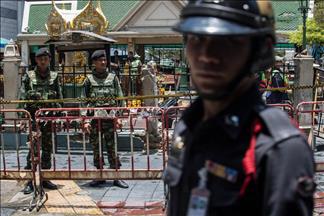
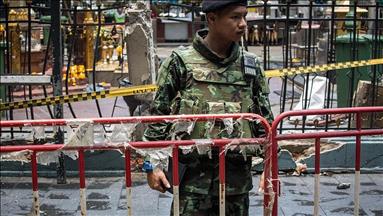
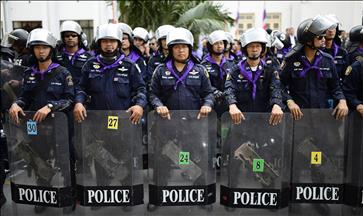
Tensions intensified in the Thai capital on Sunday night after a second deadly grenade attack within 24 hours left two people dead and more than 20 injured.
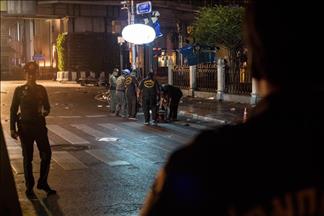
A child and an unidentified woman were killed in Sunday's attack on an anti-government rally in a popular Bangkok shopping district, while more than 20 other people were injured.
Hours after the blast a Bangkok resident - who did not wish to be named for reasons of personal anonymity - told the Anadolu Agency that pools of dried blood remained on the sealed-off road between abandoned vehicles.
The blast followed a Saturday night attack by gunmen who threw grenades at another anti-government rally in Trat province, 300km east of Bangkok.
A 5-year-old girl was killed and 30 other people injured in the incident.
Witnesses said men in a pickup truck threw grenades at People's Democratic Reform Committee (PDRC ) guards sitting near a noodle shop, while men in the second vehicle sprayed bullets at the shop before turning their guns at the stage, according to the Bangkok Post newspaper on Sunday.
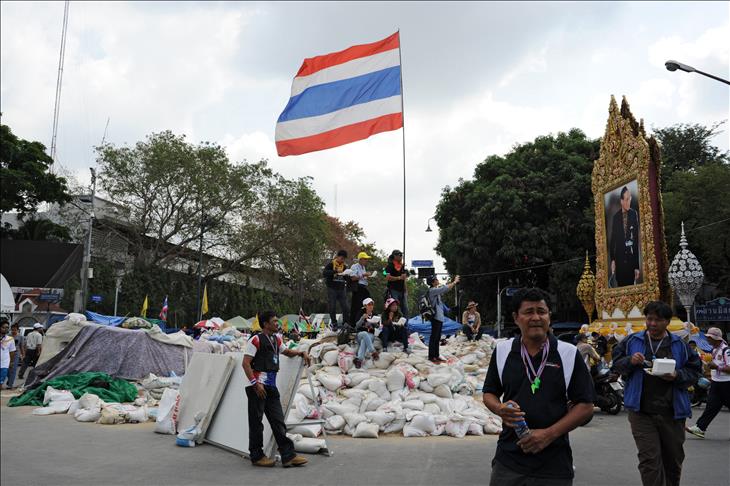
Such attacks are now occurring almost daily on rally sites for the anti-government PDRC who want Prime Minister Yingluck Shinawatra to resign and an unelected "people’s council" to run Thailand until the political system is reformed.
In Thailand's Northeast, several thousand red shirts (pro-government) met in a sports stadium in Nakhon Ratchasima on Sunday to discuss setting up a government-in-exile in the North, plus a range of other strategies, according to local media outlets.
The red shirt movement is mostly from Thailand's poorer north and north-east and is determined to maintain an administration which has delivered them clear material benefits.
Red-shirt leader and caretaker deputy Commerce minister Natthawut Saikua said 11 proposals were discussed by the pro-government group, according to The Nation newspaper.
These included a "government-in-exile" in the North or Northeast - two areas where the Shinawatra government has its strongest support.
Natthawut said the red shirt movement - or United Front for Democracy against Dictatorship (UDD) - "was all set to go to 100 percent combat mode," the paper said.
Exercising civil disobedience against "unjust" court rulings or decisions by independent agencies, and arresting the anti-government protest leader Suthep Thaugsuban were other issues discussed, it said.
UDD chairwoman Thida Tavornseth was quoted as saying red shirts had to fight to protect democracy against a military coup, against anti-government protesters, and against independent agencies and the courts, which she claimed were unjust.
The PDRC has asked the Constitutional Court to dissolve the government for "abuse of power" for its organization of the February elections, while the country's Anti-Corruption Commission gas asked the prime minister to appear before it on corruption charges.
Thailand has been lurching from one crisis to another since a 2006 coup, in which Yingluck Shinawatra's brother - Thaksin - was overthrown and then found guilty of abuse of power.
Yingluck is facing a wave of opposition protests after her government pushed through an amnesty in 2013 which would have lifted a conviction against Thaksin -- a deeply divisive figure whose Thai Rak Thai (Thais love Thais) party led the country from 2001.
Thaksin, who is said to still exert strong influence on the government, fled before the judgment and has been living in exile, mostly in Dubai.
Confronted by massive protests, the government withdrew the bill, but the opposition has alleged massive corruption by the government and Shinawatra family.
Yingluck dissolved parliament on December 9 and called February 2 elections, which were disrupted by an anti-government movement - the People’s Democratic Reform Committee (PDRC) - who want an unelected "people’s council" to run Thailand until the political system is reformed.
Thailand is deeply divided between an urban middle class which despises Yingluck's populist government and provincials in the the poorer north and north-east, determined to maintain an administration which has delivered them clear material benefits.
The conflict also puts two rival factions of the elite at opposition - the traditional establishment focused on the monarchy, comprised of old Sino-Thai business families, and a class of "new rich" Thais, who have made a fortune since the beginning of the 1980s.
The new wealth is epitomized by former prime minister Thaksin, a telecom magnate and billionaire, who is accused of massive corruption by the anti-government demonstrators, but adored by the provincials for his social policies.
According to renowned Thai political scientist Thitinan Pongsudhirak, a lynchpin of the crisis has been the will of the old elite to push away Thaksin through short-cuts - military coups or judicial coups, as in 2007 and 2008 when two pro-Thaksin political parties were dissolved by the Constitutional Court.
englishnews@aa.com.tr