By Rafiu Ajakaye
LAGOS
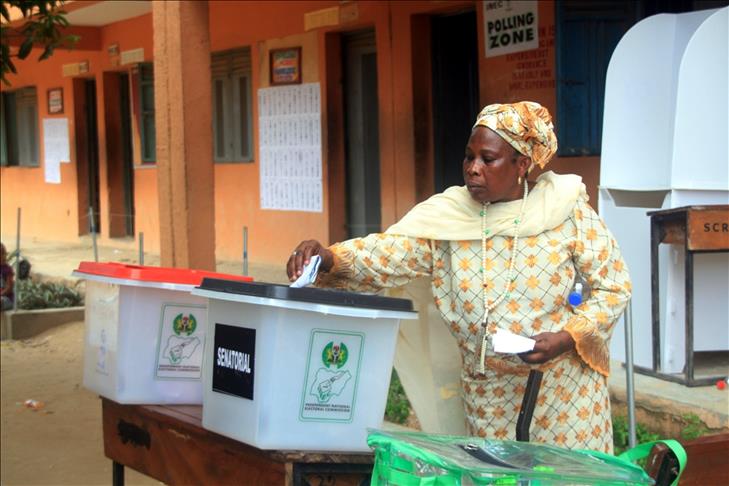
Exactly one week after electing a new president and parliament, millions of Nigerians will head back to the polls on Saturday to elect governors and state assembly members.
Although the People's Democratic Party (PDP), which has ruled the country since 1999, lost the presidency and federal parliament to the opposition All Progressives Congress (APC) of President-elect Muhammadu Buhari, state-level elections are nevertheless expected to be hard fought.
"I expect the Buhari effect will dictate how many states will vote in the governorship ballot, especially in the southwest and much of the northwest," political analyst Yinka Ajia told The Anadolu Agency.
Olusola Smith, another political observer, agrees.
He, too, believes "the Buhari effect" will "go a long way to dictating how people vote, because no Nigerian politician wants to be in the opposition."
In the northwest in particular, the APC is expected to win big in states in which it currently holds sway, the "Buhari effect" notwithstanding. The race is current pegged at 60-30 in favor of the APC.
In the northeast and north-central regions, the APC may not necessarily win big because it does not have many incumbents and because local issues are expected to largely influence the vote.
"We will wait and see if this so-called 'Buhari effect' is not overrated, especially in the northeast and even in some parts of northwest, where voters are curiously enlightened despite their low education," he said.
"Local issues, like how popular the candidate is, will play a role," asserted the analyst.
In much of the northeast, voting may not necessarily follow the same pattern of last week's presidential ballot, in which Buhari won big.
Unlike the Muslim-Christian presidential faceoff, the candidates of both the PDP and the APC are Muslim.
Local peculiarities and the personal appeal of each candidate, therefore, will play a larger role in deciding the vote in these battle ground states.
"I see a tough fight in the northeast and much of the north-central region, where local peculiarities will determine how people vote," Smith, the political observer, told AA.
"It will be tough because even states like Lagos and Kaduna could prove to be battleground states," he noted.
Although the APC has an incumbent in Nasarawa, his chances of winning aren't so bright due to local and ethno-religious issues.
Despite the APC's hold on the state, Jonathan clinched it in last week's election with 273,460 votes against 236,838 for Buhari.
The APC is largely expected to win Kwara, where it has an incumbent governor.
But it may lose in Niger, Kogi, Benue and Plateau states, where the PDP is the ruling party.
In Taraba State, meanwhile, which Jonathan won with 218,905 votes against only 168,646 for Buhari, will more than likely go to the PDP.
In the upcoming gubernatorial races, the APC is expected to win states like Lagos and much of the southwest.
But Lagos, currently ruled by the APC, may still be a surprise, partially because many people there seem to want a change of guard.
The PDP did surprisingly well in Lagos in the March 28 presidential and parliamentary polls, thanks to millions of south south/southeast residents of Lagos.
Buhari won Lagos State with 792,460 votes against 632,327 for incumbent Jonathan.
In south-south and southeastern states, the "Buhari effect" may play no role at all, because of the local population's ethno-religious composition.
Many people aren't comfortable with a Hausa-Fulani Muslim being in the saddle.
The battle is currently tipped 70-30 in favor of the PDP.
"In the southeast and south-south, the incumbency factor will play bigger roles," believes Ajia, the analyst.
"Despite Buhari having won the presidency, I do not expect the APC to do well in the two regions, except of course in Imo, which is too close to call," he told AA.
The APC's popular incumbent in Imo remains politically viable, since nearly most of the state's political elites belong to the PDP.
Jonathan won Imo state with 559,185 votes against 133,253 for Buhari in last week's poll.
In Rivers State, where the APC has an incumbent who is not running, the PDP seems certain to win, based on the ethno-religious sentiments that marked the presidential polls there.
Jonathan pummeled Buhari in Rivers State, winning 1,487,075 votes against a meager 69,238 for his rival.
Oyo in the southwest, meanwhile, will be a state to watch.
Oyo State doesn't elect a governor for two terms and it remains unclear whether the state's incumbent APC governor will be able to break the jinx.
Observers say the race is 60-40 in favor of the incumbent.
In Abia State, also in the southeast, the fringe All Progressives Grand Alliance (APGA) may swing a surprise to beat the PDP, which currently rules the state.
The APC has no chance in the state whatsoever.
Gubernatorial polls will not be held in Ekiti, Osun, Ondo, Edo and Anambra states.