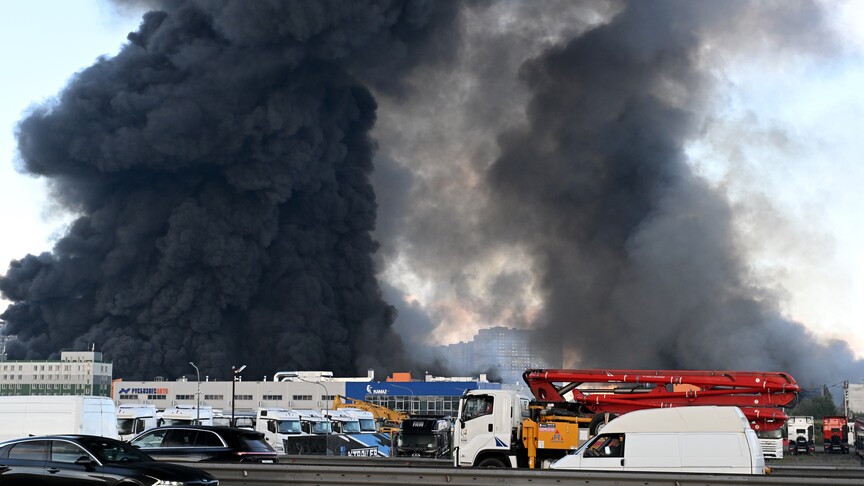
Ukrainian drone strikes against Russia’s Wildberries threaten to cripple domestic supply chains as the e-commerce giant faces an unprecedented surge in short-term debt.
Wildberries is scrambling to reorganize its logistics network after a series of coordinated attacks caused heavy damage to multiple hubs across the country, prompting the e-commerce firm to reroute operations and absorb mounting costs.
The firm’s short-term loans and debt liabilities surged nearly eightfold to $9.9 billion by the end of last year, according to the Russian Tax Service.
The destruction of major warehouses impacted the inventory and cash flow of merchants operating on the platform’s marketplace. Strikes hit facilities in regions from St. Petersburg to Moscow and from Volgograd to the Udmurt Republic since mid-July, killing at least eight people and leaving numerous people injured, according to official sources.
On July 24, Wildberries facilities in St. Petersburg and the surrounding Leningrad Region came under drone attacks, injuring three people in a fire at the Novosaratovka warehouse.
On July 29, one person was injured and around 200 workers were evacuated during a drone attack on a logistics center in the Penza region, while emergency response teams, alongside a helicopter and a firefighting train, were deployed.
A fire broke out at a facility in the Udmurt Republic’s Sarapul city amid a drone strike, but employees were evacuated before the attack and no one was injured.
Wildberries reassured the public that its supply chains at both facilities had been reorganized and that goods receipt and order shipments were continuing from other centers.
In the first week of August, Volgograd suffered a drone attack that caused fires at an energy facility and warehouses in the city, injuring five people in the region.
The city of Samara in the Volga region experienced a fire at its Wildberries logistics center after a drone attack on Aug. 2, prompting the establishment of a crisis center at the scene, with no fatalities or injuries recorded.
The facility in the Vladimir region’s Sobinsky District suffered an attack on Monday, injuring a warehouse worker and a nearby resident.
Wildberries boasts a network of more than 200 facilities, which helped it prevent a complete collapse, but the forced closures extended delivery times and inflated operational costs.
The Kremlin intervened in the crisis as Russian Deputy Prime Minister Alexander Novak tasked ministries and the Russian central bank with finalizing emergency support measures for affected sellers by Aug. 10.
Around 1,500 sellers were affected in Leningrad, and Governor Aleksandr Drozdenko said low-interest loans for working capital and additional support would be provided.
Russia’s largest bank, Sber, also began processing loan restructuring applications for small- and medium-sized enterprises (SMEs) that lost inventories.
Wildberries confirmed that support payments will cover more than 97,000 affected businesses, while its own bank has already implemented a credit moratorium and waived fees.
The e-commerce giant previously made initial payments to more than 88,000 sellers and provided storage and logistics assistance.
Moscow said the targeted warehouses were civilian commercial hubs, but Kyiv insists the sites stored drone and navigation components serving dual-use purposes.
Ukrainian President Volodymyr Zelenskyy said the operations were carried out as countermeasures to degrade Russian military production capabilities, mirroring Moscow’s attacks on Ukrainian infrastructure.
Neither Wildberries nor Russian authorities have released comprehensive figures on total physical losses, the volume of destroyed inventory, or facility recovery timelines despite the widespread damage.
Wildberries’ short-term financing burden and the financial impact of the drone attacks came at an unfortunate time, as the attacks coincided with a period of rapidly mounting short-term financing needs.
The e-commerce platform’s long-term loans and debt stood at $354.1 million by the end of the year, while its total assets reached a little more than $16 billion, and its short-term liabilities also reached around $16 billion.
The firm generated $14.5 billion in revenue and $682.3 million in net income, while its net cash flow from operating activities showed a deficit of $4.6 billion.
Amid Wildberries’ network expansion plans is the planned commissioning of a new warehouse in Kazakhstan.
Arman Shakkaliyev, Kazakhstan's trade and integration minister, said around 260,000 square meters (64.2 acres) of new warehouse space will be commissioned for the company in the first half of 2027, 160,000 square meters (39.5 acres) of which will be in Astana and 100,000 square meters (24.7 acres) of which will be in Almaty.
Shakkaliyev said Wildberries currently leases around 46,000 square meters (11.3 acres) of space in the country, while no new applications for additional capacity have been made following the attacks, and previous investment plans remain unchanged.
Russian Deputy Foreign Minister Mikhail Galuzin said efforts were underway to integrate the Russian and Kazakh markets prior to the attacks, as hundreds of thousands of Kazakh suppliers are registered on Wildberries and another e-commerce platform, Ozon.