A call by Anthropic CEO Dario Amodei to slow the development of increasingly powerful artificial intelligence (AI) models has opened a new front in the US-China technology rivalry, highlighting how difficult it could be for the world’s two leading AI powers to cooperate on safety.
Amodei argued in an essay this month that rapid advances in AI, including systems increasingly capable of helping develop their successors, risk outpacing researchers’ ability to understand and control them.
“We must slow the pace at which we improve the capabilities of AI models,” he wrote. “Progress will still seem fast, and we must make wise use of the time we gain.”
His proposal calls for independent evaluators embedded inside leading AI companies, coordination among companies and governments in democratic countries, and eventually international agreements governing the pace of frontier AI development.
OpenAI CEO Sam Altman, Google DeepMind co-founder Demis Hassabis and SpaceXAI's Elon Musk publicly backed aspects of Amodei’s proposal, an unusual convergence among leaders of fiercely competing AI companies.
But according to the administration of US President Donald Trump, the idea quickly runs into a geopolitical problem: China.
Trump has rejected calls for Washington to deliberately slow AI development, framing the issue primarily as a competition with Beijing.
“We're leading China in AI. We're the most sophisticated country in the world, and frankly, I want to keep it that way because whoever wins AI wins,” he told reporters Sunday.
Trump intensified his criticism Monday, questioning why industry leaders would seek rules that could constrain their own companies.
“When, in the History of Business, did anyone see the Leaders of an Industry call for Regulation that, if strongly implemented, will drive them into oblivion and bankruptcy?” he wrote on his proprietary social media platform Truth Social.
He also described opposition to AI and data centers as a “SICK conspiracy,” adding that “the only one that is happy about it is China.”
Amodei himself acknowledged the dilemma. His proposal argues that slowing US development without equivalent restrictions on China could give Beijing a decisive technological advantage.
“Global pacing will require cooperation with China,” he wrote, but warned that any agreement would require “ironclad verifiability” or safeguards strong enough to prevent one side from gaining a potentially decisive military advantage by secretly breaking the rules.
China has responded skeptically to warnings from US technology leaders, particularly Amodei’s argument that Washington should maintain restrictions on exports of advanced chips and semiconductor manufacturing equipment to China.
“Fear-mongering, confrontation and vicious competition will only hamper efforts toward sound global AI governance, which serves no one's interest,” Chinese Foreign Ministry spokesperson Guo Jiakun said Monday.
“AI is a consequential technology for the well-being of all humanity. All parties should jointly promote the open and inclusive development of AI for good and for all,” he added.
The state-backed Global Times went further in an opinion article, portraying Amodei’s proposal as an attempt to preserve US technological dominance.
“This ‘silent AI Cold War’ is hypocritical and short-sighted,” the newspaper said, arguing that the proposal sought to restrict China through technological barriers while excluding it from global AI governance.
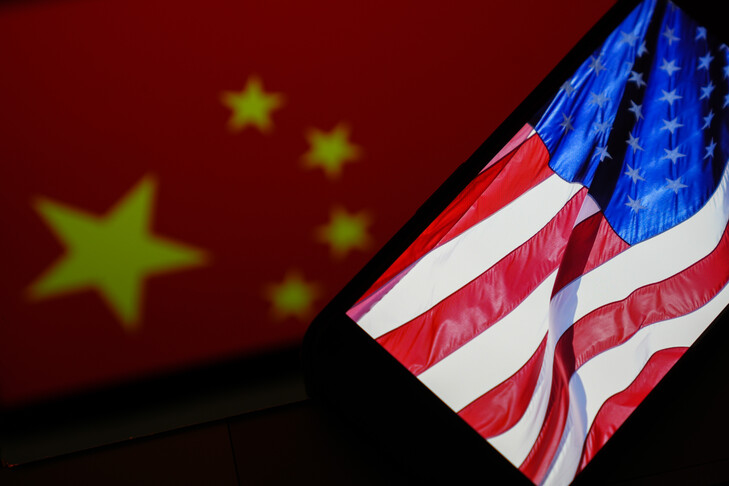
The contrasting reactions underline a central obstacle to any international slowdown: Washington fears that restraint could allow China to overtake it, while Beijing suspects that US safety proposals could be used to constrain Chinese technological development.
The debate comes as reports say the US retains an overall lead in frontier AI but Chinese companies continue to narrow parts of the technological gap.
Chinese developers including DeepSeek, Moonshot AI, Z.ai and Alibaba have produced increasingly competitive models despite US restrictions on access to the most advanced chips, according to assessments of the sector.
Researchers in China nevertheless generally see US laboratories as further ahead in the most advanced AI capabilities.
“AI progress is happening faster and it’s more frontier in the U.S., so people at U.S. labs may see more dangerous things than people in Chinese labs,” Zilan Qian, a researcher at the Oxford China Policy Lab, was quoted as saying by The Wall Street Journal.
China itself has increasingly acknowledged AI risks. President Xi Jinping has called for measures to prevent “loss of control,” while Chinese regulators have incorporated such concerns into the country’s AI safety framework.
However, Beijing simultaneously treats AI as a strategic technology central to economic development and competition with the US.
Kenton Thibaut, a China fellow at the Atlantic Council, said significant barriers remain despite some overlap between US and Chinese concerns about AI safety.
China suspects Washington could use safety negotiations to constrain its technological rise, while US officials have doubts whether agreements with Beijing could be reliably verified and enforced, she wrote in an article.
“China appears suspicious that the US would use the guise of AI safety talks to seek to constrain China and promote its own tech dominance,” Thibaut said.
She argued that a comprehensive slowdown agreement is highly unlikely in the near term, but narrower cooperation — such as measures to prevent AI-enabled biological weapons, common testing standards or mechanisms to avoid misinterpreting rogue AI activity as a deliberate state attack — may be more realistic.
The issue is taking on added significance ahead of a planned Sept. 24 meeting between Trump and Xi in Washington. AI governance could be among the subjects raised as both governments confront the same underlying dilemma: how to reduce the risks of increasingly capable AI without surrendering an advantage each considers critical to its economic and national security.
news_share_descriptionsubscription_contact