
The rapid rise of generative artificial intelligence (AI) has led to growing legal scrutiny of how major technology companies collect and use data to train their systems.
Regulators and courts worldwide are focusing on issues such as copyright infringement, lack of consent for personal or biometric data, and transparency in AI development.
A June analysis by cybersecurity company Surfshark found that AI-related fines and settlements imposed on seven major technology companies have totaled about $3.5 billion since 2022.
On the other hand, the cumulative data privacy fines imposed by European watchdogs since 2018 have surpassed €7.1 billion ($7.7 billion).
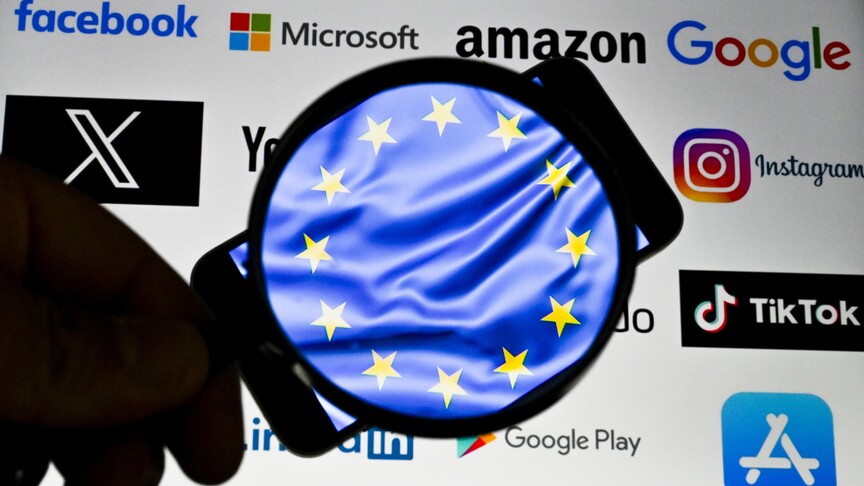
This regulatory pressure has also fueled an ongoing geopolitical tension between the US and the EU.
President Donald Trump has repeatedly criticized EU fines against American tech firms as "discriminatory" and "unfair," while EU officials have insisted the penalties simply enforce rules that apply equally to all companies doing business in the 27-nation bloc.
Tesla and X owner Elon Musk called for the EU to be "abolished" after Brussels fined his platform X with a €120 million ($140 million) penalty in December 2025.
The Claude AI developer agreed to pay $1.5 billion to settle a class-action lawsuit brought by authors who accused it of downloading millions of pirated books from unauthorized online libraries to train its models.
A federal court in California granted final approval to the deal on Monday.
It is described by legal trackers as the largest copyright settlement in US history.
Payments of roughly $3,000 per qualifying book are expected to go out to authors and publishers, including Bloomsbury, the UK publisher of the Harry Potter series, which confirmed this week that nearly 14,100 of its titles are eligible for compensation.
Anthropic did not admit wrongdoing and has said it believes using copyrighted works to train AI is protected under the "fair use" doctrine of US law.
In May 2023, Meta was fined a record €1.2 billion ($1.3 billion) by Ireland's Data Protection Commission over Facebook's transfer of European users' personal data to the US.
The parent company of Facebook and Instagram, also agreed to pay $1.4 billion to settle a major data privacy lawsuit regarding its AI training foundations in July 2024 -- the largest privacy settlement ever obtained by a single US state.
The state of Texas sued the social media giant under its 2009 Capture or Use of Biometric Identifier (CUBI) Act.
It argued that Meta's now-discontinued "Tag Suggestions" feature automatically captured the facial geometry and biometric mappings of millions of users without securing their explicit, legal consent.
This immense database of scraped biometric material was then used to train its underlying commercial facial recognition AI systems.
Meta shut down the feature and deleted more than a billion facial-recognition templates, but did not admit wrongdoing in the settlement.
France's competition authority fined Google 250 million euros ($271 million) in March 2024 for failing to honor commitments it had made to French news publishers and press agencies over compensation for their content.
The regulator found that Google's AI chatbot, Bard, now known as Gemini, had used content from press agencies and publishers to train its underlying model without notifying them, and that the company failed to offer a way for publishers to opt out of AI training without also losing visibility in regular Google search results.
Google did not contest the findings and settled the case under a formal settlement procedure.
The European Commission also fined Google 890 million euros ($1.02 billion) Thursday for breaching the EU's Digital Markets Act by favoring its own shopping, travel and other services in search results, and by restricting app developers from steering users toward cheaper deals outside its Play Store.
Announcing the decision, the Commission said it is separately examining whether Google's newer AI Overviews and AI Mode search features raise similar competition concerns, and gave the company 60 days to comply with the ruling or face further penalties of up to 5% of its global revenue.
Apple agreed in late 2024 to pay $95 million to settle a class-action lawsuit accusing its Siri voice assistant of recording users' private conversations without their consent, including during accidental activations when the "Hey, Siri" trigger phrase was not used.
A US judge gave final approval to the settlement in September last year.
Apple did not admit wrongdoing but agreed to confirm it had deleted improperly captured recordings.
Italy's data protection authority, the Garante, fined OpenAI 15 million euros ($15.6 million) in December 2024, in what was described as the first European privacy fine against a generative AI company.
Regulators said OpenAI trained ChatGPT on people's personal data without a proper legal basis, failed to report a March 2023 data breach, and lacked age-verification tools for users under 13.
OpenAI called the penalty disproportionate and appealed.
On March 18 this year, a Rome court completely annulled the Italian regulator's fine and the accompanying order for OpenAI to run a public awareness campaign on procedural grounds.
The New York Times also sued OpenAI and its partner Microsoft in December 2023, alleging the companies used millions of its articles without permission to train ChatGPT.
The case remains in the discovery phase in a New York federal court, with no trial date set.
In 2021, e-commerce and cloud giant Amazon was fined €746 million ($815 million) by Luxembourg's data protection authority over allegations that its processing of customer data for advertising purposes violated GDPR rules.
Amazon rejected the findings and said the decision related to how customers' advertising preferences were interpreted rather than a data breach.
The company also agreed to pay a $25 million civil penalty to US regulators, the Federal Trade Commission (FTC) and the Justice Department, over allegations that its Alexa voice assistant unlawfully retained children's voice recordings and location data for years, in violation of federal child privacy law.
A separate, ongoing class-action lawsuit by Alexa device owners, alleging the assistant recorded private conversations without proper consent, was allowed to proceed toward trial by a US judge in 2025 and 2026, with claims under Florida, Maryland and federal wiretapping law still active.
The US facial-recognition company has been targeted by a coalition of international regulatory bodies, including authorities in the UK, France, Italy, and Australia.
Clearview AI built a commercial database of over 30 billion images by systematically scraping public profiles, photos, and personal data from social media platforms.
Regulators worldwide ruled that harvesting biometric data to sell real-time identity-matching software to law enforcement agencies violates fundamental privacy rights.
France's CNIL and Italy's Garante each fined the company 20 million euros, while the Netherlands' data protection authority imposed a 30.5 million euro fine in 2024 and ordered Clearview to stop operating in the country.
According to the advocacy group Privacy International, Clearview's breaches in France, Italy, Austria and Greece alone have resulted in fines totaling 65.2 million euros.
Clearview has argued it has no legal presence in the EU and is therefore not bound by the bloc's rules, an argument a UK tribunal rejected in October 2025.
news_share_descriptionsubscription_contact