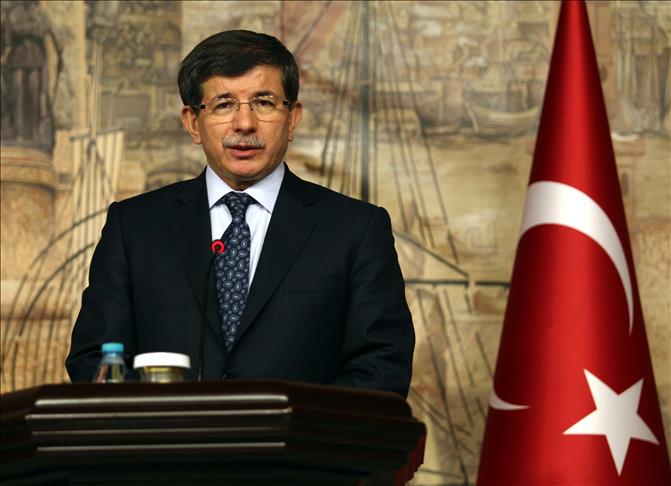
ANKARA (AA) - July 31, 2012 - "A new vision for least developed countries (LCD)" article written by Turkish Foreign Minister Ahmet Davutoglu points out the economic and ecological challenges that LDCs face and what the developing points of these countries can be.
Article published by the Center for Strategic Research of the Ministry of Foreign Affairs of the Republic of Turkey (SAM) points that as Turkey is growing economically fast in the past few years, Turkey started concerning the human inequality which is still taking place in the world largely.
After visiting Somalia in 2011, Turkish leaders wished to raise the awareness towards Somalia and make globe aware that what LDCs are going through. Turkish leaders received great appreciation from Somalian people for their famine help and started building the global response in order to resolve the problems of Somalia. In the article Davutoglu focuses on the lack of human security in Somalia which causes the sustained civil strife and uncontrolled crime and he also claims that countries which go through the rapid growth provide advantages to the whole of world society.
Davutoglu focuses on three criteria of United Nations (UN) for LDCs and what they have to achieve in order to "graduate" from the LDC to developing country status. He highlights that Turkey expresses the needs and concerns of African countries, stands as the voice of Africa during international meetings such as in G-20 and says, "Turkey wanted to raise consciousness in the global setting about the tragedy of Somalia so other countries would join in the emergency relief effort." Davutoglu states in the article that they would like to cooperate with the international community to "find a more satisfactory policy, one that is acceptable to the LDCs and their developmental partners, to replace this invidious “graduation” system." Touching to the challenges of LDCs, Davutoglu lists some of these countries' problems,such as, "Underdevelopment, lack of infrastructure such as electricity, sanitation, clean and accessible drinking water, weak production capacities, weak institutional capabilities to shape and implement policies, lack of financial resources, low level human development, low labor productivity, overdependence on few export commodities, brain drain of talent." He also adds, "Many LDCs are situated in those climate zones that are experiencing the high end of global warming."
Furthermore, Turkish FM Ahmet Davutoglu underlines Turkey's support to LDCs and touches to the word "development" by mentioning, "We made it clear during the UN Conference, and in discussions with the Secretary General, of dissatisfaction with the language used to categorize these countries as ‘least developed."
He states that he informally suggested to rename the LDC to "Future Developing Countries (FDCs)" and says, "The Turkish Government will take this unilateral step informally by describing the 48 countries officially embedded in the UN's LDC lexicon as FDCs in its communications relating to this group of countries. The negative connotation of LDC is further reinforced by the procedure known in UN circles as ‘graduation’ by which economic progress allows a country to escape from the LDC stigma, and will now be identified by dropping the word ‘future’ from the FDC designation."
Turkish Minister Davutoglu notes the support of Turkey to LDCs by saying, "Turkey seeks especially to take steps allowing the LDCs to benefit from trade among themselves, and to do so by strengthening procedures for regional cooperation and integration. The basic aim of Turkish assistance is well expressed by the familiar proverb: “give someone a fish and he will be fed for a day, teach that person to fish, and he will be fed for a lifetime.”
Davutoglu also mentions about the Turkish assistance, "Turkey seeks to foster a new development paradigm that stresses acceleration of development, sustainability with respect to environment limits, inclusiveness with respect to the outreach toward beneficiaries of economic growth, and equitable distribution of benefits of growth as between various sectors of society, including relations between country and city. It is a perspective associated with kadim (ancient wisdom) that partakes of eternal truth, and serving as the keystone of the visionary diplomacy that Turkey embraces as essential if real progress is to be achieved on behalf of this group of countries."
Davutoglu states clearly in his article that they are not targeting to gain any advantages from their support and says, "Turkey indicated that its commitment to the LDC process is without any interest in securing special access to the countries that are embraced within the UN framework."
Moreover, he bulletpoints the development tactics for "LDCs or (FDCs)" by saying that Turkey will try to improve development tactics and strategies for coming over the poverty and human inequality that FDCs face and he says, "We are searching for a path on high and safe ground situated between the social and political demands for development and the necessities of sustainability."
Davutoglu concludes his article by stating that to fulfill the needs of FDCs (or LDCs), they need to realize their dreams of a better life and says, "I am reminded of the words of the French philosopher, Jacques Derrida, who formulated the greatest task facing humanity as learning to live well together on this planet."