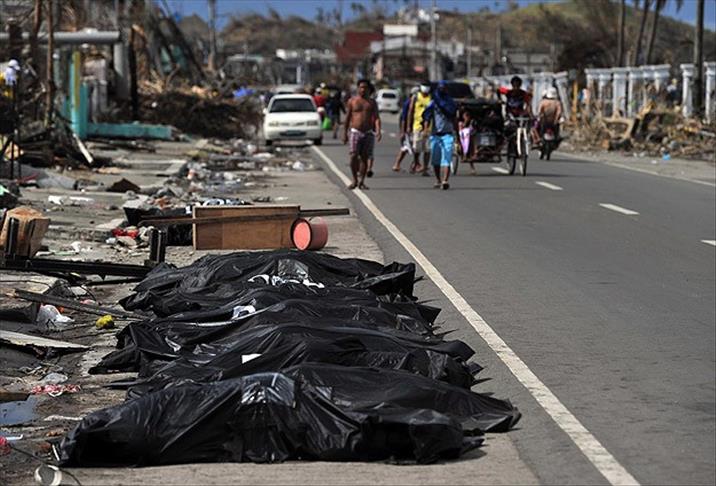
The city of Tacloban, the worst-hit by the deadly typhoon which wrecked the Philippines on the weekend, is in ruins with the bodies of victims still lying in the streets, says the AA team on the ground.
Typhoon Haiyan, reaching speeds in excess of 350 km per hour, wreaked havoc on several central islands in the archipelago nation, leaving 2,275 people dead, 3,665 wounded and over 600,000 displaced, according to government figures.
The death toll is feared to rise significantly as the worst-hit areas slowly become accessible.
AA reporters say the humanitarian situation is becoming worse by the hour as rescue efforts continue.
The Philippines government says it is struggling to provide shelter for the displaced and to restore transport, power and communication to the affected regions.
Risk of epidemic in Philippines
World Health Organization (WHO) has warned typhoon-struck Philippines of possible epidemics.
WHO's Head of Public Relations Gregory Hartl said the relief materials have been delivered to the country and now it is time to distribute them.
Underlining the difficulty of reaching the needy people in the disaster area, Hartl warned that there is a high risk of epidemics such as cholera and diarrhea because of malnutrition and lack of drinking water. Hartl added that health teams in the region are also fearing of tetanus.
Meanwhile, the Philippine Department of Health announced that they have not seen any epidemic case in the disaster zone so far. In a press conference held in capital Manila, Minister of Health Enrique Ona said that they came across pneumonia and influenza, but these cases are not enough to talk about an epidemic.
WHO Representative to the Philippines Julie Hall highlighted the importance of breast-feeding the newborns. Hall said it is dangerous to feed them with formula due to shortage of potable water.
englishnews@aa.com.tr