ANKARA
As the Muslim world celebrates Eid al-Adha, Turkish leaders have called for mutual understanding and respect for differences in society in messages they released.
The Muslim world except Iran, Morocco, Pakistan and Mauritania, began the first day of the four-day-long Eid al-Adha holiday on Tuesday.
Turkish leaders, calling for mutual understanding and respect for differences in society, offered their greetings in messages they released to mark Eid al-Adha.
Calling for peace, President Abdullah Gul said, "We can preserve our unity only through respecting our differences and by showing sympathy towards each other, which is the key tool to lift Turkey to a more prosperous level."
“I hope the best for our country on this feast of Eid al-Adha and send my greetings to all Islamic countries, wishing that this feast will put an end to violence all over the world, in our neighboring territories especially,” Gul added.
Turkish Prime Minister Recep Tayyip Erdogan also issued message to mark Eid al-Adha, offering his holiday greetings to people in Turkey and Islamic communities.
“There is the soul of peace within this geography. We all share a fate, share a faith. Thank Allah, progressing all together, with the soul of unity, we managed to get over all the adverse conditions we went through as a community with many trying to ruin the sense of unity within our nation," Erdogan said.
Turkish Foreign Minister Ahmet Davutoglu, meanwhile, congratulated Eid al-Adha (also called feast of sacrifice) of all Turkish citizens as well as Muslims living in other countries.
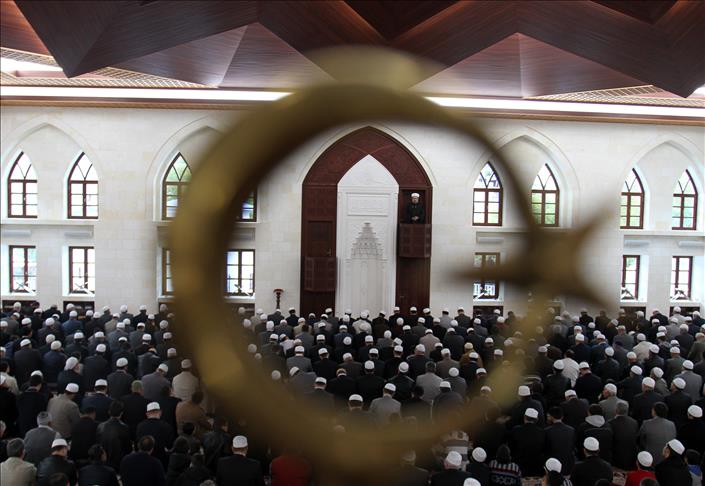
He practised the Eid prayers early in the morning with his fellow countrymen in Turkey's central Anatolian province of Konya.
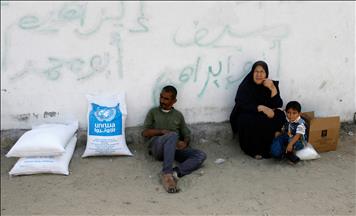
"We deeply feel and share the pains of our brothers in Syria, Egypt, Palestine, Gaza, Myanmar, Somalia, and all across the world," Turkish minister noted. "Millions of Muslims around the world cannot fully enjoy the Eid because of the pains and troubles. May Allah bless them help and patience."
According to figures announced by Saudi officials, this year 1.3 million Muslim pilgrims gathered on Mount Arafat near Mecca on Monday, marking the most important and essential ritual of the hajj pilgrimage.
Muslims from 188 different countries traveled to Saudi Arabia for the hajj this year.
What does Eid al-Adha commemorate?
Eid al-Adha, also called Feast of the Sacrifice, is an important religious holiday celebrated by Muslims worldwide to honor the willingness of the prophet Abraham to sacrifice his young first-born son Ishmael as an act of submission to Allah's command and his son's acceptance to being sacrificed, before Allah intervened to provide Abraham with a Lamb to sacrifice instead.
Muslims remember and commemorate the trials and triumphs of the Prophet Abraham. The Qur'an describes Abraham as follows:
"Surely Abraham was an example, obedient to Allah, by nature upright, and he was not of the polytheists. He was grateful for Our bounties. We chose him and guided him unto a right path. We gave him good in this world, and in the next he will most surely be among the righteous." (Qur'an 16:120-121)
In the lunar Islamic calendar, Eid al-Adha falls on the 10th day of Dhu al-Hijjah and lasts for four days. In the international Gregorian calendar, the dates vary from year to year, drifting approximately 11 days earlier each year.
Eid al-Adha is the latter of the two Eid holidays, the former being Eid al-Fitr. The basis for the Eid al-Adha comes from the 196th verse of the 2nd sura of the Quran.[4] The word "Eid" appears once in the 5th sura of the Quran, with the meaning "solemn festival".
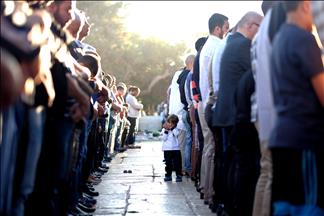
Like Eid al-Fitr, Eid al-Adha begins with a Sunnah prayer of two rakats followed by a sermon (khuṭbah). Eid al-Adha celebrations start after the descent of the Hajj from Mount Arafat, a hill east of Mecca. Ritual observance of the holiday lasts until sunset of the 12th day of Dhu al-Hijjah.
Eid sacrifice may take place until sunset on the 13th day of Dhu al-Hijjah. The days of Eid have been singled out in the Hadith as "days of remembrance". The days of Tashriq are from the Fajr prayer of the 9th of Dhul Hijjah up to the Asr prayer of the 13th of Dhul Hijjah (5 days and 4 nights).
This equals 23 prayers: 5 on the 9th-12th, which equal 20, and 3 on the 13th.