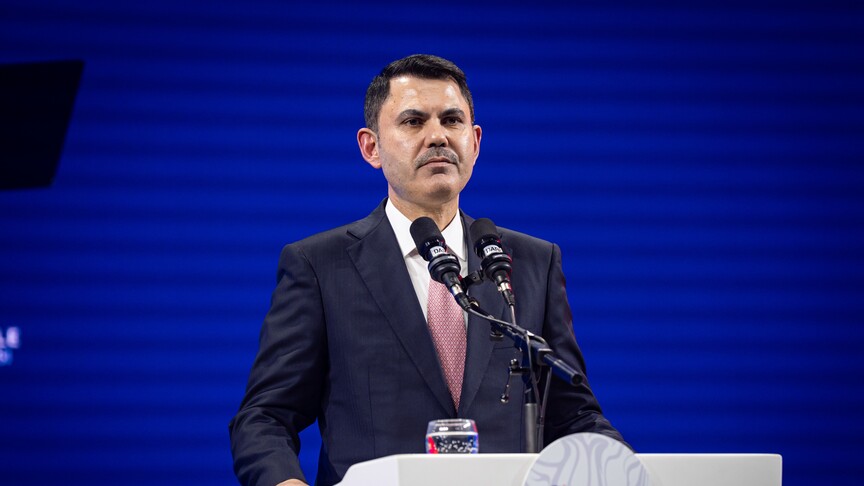
COP31 President and Turkish Environment, Urbanization and Climate Change Minister Murat Kurum called for a fairer global climate framework that protects developing countries' right to development, facilitates access to financing and technology for vulnerable nations, and ensures that all countries benefit from the green transition.
"We can establish a system that respects the right of developing countries to development, facilitates vulnerable countries' access to financing and technology, and ensures that everyone benefits from the transition," Kurum said Wednesday in Antalya, Türkiye, the venue for the COP31 UN Climate Change Summit.
"Under the leadership of our President (Recep Tayyip Erdogan), Türkiye is ready to contribute to this consensus through its historical and geographical experience bridging East and West, North and South," he said at the opening of the High-Level Segment of the COP31 Leaders' Summit.
He cited how, in the 16th century, Ottoman Sultan Suleiman the Magnificent commissioned architect Mimar Sinan to develop a water supply system that would serve Istanbul for centuries, saying this story highlights the need to anticipate future needs through decisions made today.
He added that the "Century of Türkiye" vision, introduced by Erdogan, similarly looks toward the second century of the Turkish Republic with a long-term perspective.
He said the vision, which includes a target of achieving net-zero emissions by 2053, reflects Türkiye's determination to shape its cities, energy systems, industry, technology and environment with future generations in mind.
Kurum said the importance of long-term planning had become particularly evident following the February 2023 devastating earthquakes in southeastern Türkiye.
"Following that great tragedy, we launched one of the largest reconstruction mobilizations in world history to rebuild our cities. Our architects, engineers, workers, public institutions and local administrations worked together across thousands of construction sites," he said.
He noted that Türkiye had rebuilt homes, workplaces, infrastructure, roads, schools and hospitals, delivering 455,000 housing units to their rightful owners.
Turning to the changing global landscape, Kurum said geopolitical balances and trade routes were shifting, while technology and artificial intelligence were transforming production.
He added that energy security was becoming increasingly important, rising debt was narrowing countries' development opportunities, and water and food security were emerging as major national security concerns.
Climate change, he said, was increasingly intertwined with all these challenges.
"As the world's challenges become more interconnected, the horizons of governance must also expand. Climate change has become an integral part of the agendas of energy, industry, agriculture, development and even security.
"Therefore, when we discuss the future of the climate, we are also discussing the future of our countries, our energy systems, the competitiveness of our industries, the safety of our cities and the world in which our children will live. This is why the political will represented in this room is so valuable," Kurum said.
Kurum described the 1.5C (2.7F) target as a common compass for global climate action while noting that the global average temperature in 2024 exceeded pre-industrial levels by 1.5C on an annual basis.
He warned that climate-related disasters were occurring with increasing frequency.
Referring to the impacts of climate change around the world, he highlighted the challenges facing small island nations in the Pacific, which are struggling to protect their future from rising sea levels. He also noted that natural climate phenomena such as El Nino could temporarily increase global temperatures.
"We must recognize the value of time and strengthen our capacity to implement solutions without delay. Of course, every country has different circumstances, resources, economic capacities, development needs and responsibilities.
"Our collective success depends on our ability to identify common interests despite these differences," he said.
Kurum stressed that climate action and national interests were not mutually exclusive but closely interconnected.
"Energy efficiency strengthens energy security, while investment in water resources strengthens food security. Clean technologies create opportunities for industry and employment, while resilient cities strengthen economies.
"Properly designed climate action is an investment in prosperity, security and competitiveness," he said.
He added that since assuming the COP31 presidency, Türkiye had been working with Australia, which is leading the negotiations, to advance three key priorities in Antalya.
The first priority, he said, was to translate national climate targets into investment programs and ensure that commitments were reflected in national budgets.
Kurum highlighted the 35 by 35 Global Electrification Pledge as an expression of the commitment to a just energy transition. The initiative aims to increase electricity's share of final energy consumption to 35% by 2035, creating opportunities for global cooperation on energy security and technological transformation.
He also stressed that development models based on unlimited resources and the assumption that the planet could sustain endless consumption were no longer sustainable.
"That is why we regard the Zero Waste movement, launched under the leadership of first lady Emine Erdogan, together with the circular economy and the reduction of methane emissions, as concrete objectives of climate action," he said.
The second priority was to move beyond financial pledges toward actual access to climate financing.
Kurum warned that projects often waited years for funding and that the failure to convert financial resources into investments, or the imposition of excessive debt burdens on countries, resulted in lost time and weakened collective capacity to find solutions.
He called for urgent efforts to strengthen mechanisms that would make climate financing faster, more accessible and easier to implement.
"As the COP31 Presidency, the Climate Implementation Bridge we have developed will address this need. We will support the transformation of political will into tangible investments by connecting national plans with projects, projects with financing, and financing with technology and expertise," he said.
The third priority, Kurum added, was to place resilience at the center of national development policies by preparing cities, water resources, agricultural systems and critical infrastructure for future risks.
He said Türkiye was ready to share its reconstruction experience in earthquake-affected regions with countries facing climate-related disasters, citing the construction of 500,000 climate-resilient homes over two years.
Kurum said the fundamental principle underpinning all three priorities must be justice. Climate justice, he argued, requires a system in which every country can work toward common goals in line with its own resources, capabilities and development circumstances.
"We can establish a system that respects the right of developing countries to development, facilitates vulnerable countries' access to financing and technology, and ensures that everyone benefits from the transition.
"Under the leadership of our president, Türkiye is ready to contribute to this consensus through its historical and geographical experience bridging East and West, North and South," he said.
He emphasized that although countries could compete and firmly defend their national interests, cooperation was essential in areas such as water, food, natural disasters and climate risks, which transcend national borders.
"Developing a shared understanding is in everyone's interest. We have such an opportunity before us today. An energy decision we make today could serve a country's energy security half a century from now.
"A water basin we protect could bring abundance to the tables of children not yet born. A city we make more resilient could save thousands of lives years from now.
"A technology we put into action could transform the lives of millions of people in another part of the world. This is where the horizon of leadership begins: making decisions that will outlive our terms in office," Kurum said.
Returning to the historical example of Suleiman the Magnificent and Mimar Sinan, he said the Ottoman sultan had recognized the future needs of an entire city in just a few drops of water. He added that the Century of Türkiye vision similarly reflected a commitment to future generations.
"The responsibility before us in Antalya today is to look toward the common future of all humanity with that same long-term vision. Let us read tomorrow's needs in today's signs.
"Let us leave our children a future whose consequences they will experience, rather than one whose decisions we will have to explain to them. Let us make Antalya a symbolic city of the transition from pledges to implementation," he said.
Kurum concluded by expressing hope that future generations would look back on the leaders gathered at the summit and recognize their commitment to long-term action.
"Years from now, when future generations look back at our time in this room, let them be able to say: 'They saw the future, took responsibility and made decisions that would outlive them.'"
news_share_descriptionsubscription_contact

contact_the_ombudsman
is_there_an_error_in_this_story