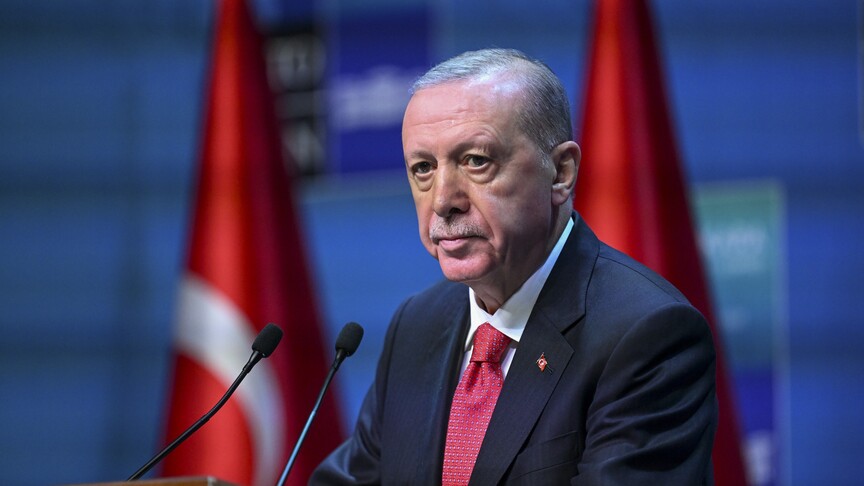
Turkish President Recep Tayyip Erdogan stated on Wednesday that the 2026 NATO summit in the capital Ankara concluded "successfully," describing it as a "historic" gathering that will help shape the alliance's future at a time of heightened security challenges across the Euro-Atlantic region.
"We have successfully concluded our NATO summit, which we hosted in our country for the second time in 22 years and for the first time in our capital, Ankara," Erdogan said at a news conference following the conclusion of the summit.
He said the meeting came at a critical moment for Euro-Atlantic security and would have lasting significance for the alliance.
"This historic summit, which we hosted at a time when Euro-Atlantic security is being tested, has been conducted in a manner that will shape our common future," he said.
Erdogan said Türkiye has had to contend with regional crises and terrorism for decades without benefiting from the post-Cold War "peace dividend" enjoyed by many European countries.
"There were times when we were left alone and treated unfairly. Therefore, we often had to rely on our own capabilities," he said.
He noted that those efforts have enabled Türkiye to surpass many NATO allies in defense spending, military capabilities and the strength of its defense industry.
"Today, in terms of defense spending, military capabilities and the defense industry that underpins them, we are well ahead of many allies," Erdogan said.
The president added that NATO leaders reviewed the implementation of commitments made at last year's summit in The Hague and reaffirmed Türkiye's plans to further increase its contributions to the alliance.
Highlighting Türkiye's military role within NATO, Erdogan said the country commands the alliance's second-largest land force and has long served as the cornerstone of security on NATO's southeastern flank.
"We currently command NATO's second-largest land army. For decades, the security of NATO's southeastern flank has largely been entrusted to our country," he said.
He said Türkiye remains among the leading contributors to NATO operations, missions and common funding, adding that Turkish F-16 fighter jets will be deployed to Estonia beginning in August as part of NATO's Air Policing mission.
Erdogan also said Ankara will continue leading the NATO-led Kosovo Force (KFOR) until September 2026 and is scheduled to command the NATO Response Force in 2028-2029.
Highlighted Türkiye's defense industry, Erdogan said the country is among the few NATO members capable of producing its own fighter aircraft, tanks, naval vessels and air defense systems.
He added that Ankara has become a global leader in unmanned aerial vehicles, naval drones and warship production while also supplying defense products to allied nations.
Erdogan reiterated that EU defense initiatives should complement NATO, rather than duplicate its efforts.
"The European Union's defense initiatives must complement NATO and avoid unnecessary duplication. I draw the attention of our allies and the EU leadership to this important point at every opportunity and in every forum," he said.
Erdogan also renewed his call for the removal of remaining restrictions on defense trade among NATO allies.
"Although some obstacles to defense industry trade among allies have decreased, they still exist. These restrictions must be removed as soon as possible, without conditions," he said.
Erdogan said his US counterpart Donald Trump has taken a "positive approach" on delivering F-35 fighter jets to Türkiye, while also saying that US sanctions against Ankara have been largely removed.
The Turkish president said he was optimistic that Ankara would eventually receive the fifth-generation fighter jets.
"Mr. Trump actually has a positive approach toward Türkiye on the F-35 issue. Hopefully, when the F-35s are delivered to Türkiye, the whole world will say, 'America kept its promise,'" Erdogan said.
In 2019, during Trump's first term, the US suspended Türkiye from the F-35 program after objecting to its purchase of Russia's S-400 missile defense system, claiming the Russian system would endanger the fighter jets.
Türkiye has repeatedly said there is no conflict between the two systems and proposed a commission to study the issue. Ankara also says it fulfilled its obligations on the F-35s and that its suspension violated the rules, maintaining that the jets would strengthen not only Türkiye, but also NATO.
Responding to a question about US sanctions, Erdogan said Washington is no longer actively implementing sanctions against Türkiye.
"At the moment, the United States is not applying any sanctions against us. To a large extent, they have been lifted," he said.
Erdogan added that senior Turkish officials, including the country's defense minister, foreign minister, chief of the general staff and vice president, had firsthand knowledge that the restrictions were no longer being enforced.
He also praised his communication with Trump, saying the US president responds quickly when contacted.
"Whenever we need to reach Mr. Trump, he gets back to us within 24 hours, and we receive the necessary response," Erdogan said.
The Turkish president said defense cooperation would remain "one of the key pillars" of Turkish-US relations, alongside expanding economic ties.
"It is in Türkiye's interest to develop our economic relations with the United States, and America also agrees with this," he said, adding that both he and Trump shared the same view during their bilateral discussions.
Erdogan also highlighted Türkiye's growing defense industry, particularly its unmanned aerial vehicle sector.
He pointed to Turkish defense company Baykar as an example of the sector's success.
"Baykar is taking an important step, and this process continues. They are receiving very serious orders from around the world and continue to do so. This shows that our unmanned aerial vehicles and armed drones have found acceptance globally," Erdogan said.
Erdogan also said he reached an understanding with Trump to expand cooperation in the defense and economic fields, although he did not provide a timeline for further agreements.
"I wouldn't call it a timetable, but Mr. Trump and I reached an understanding on this issue," he said.
The Turkish president said the two leaders discussed possible joint projects in the defense sector, including naval construction.
"We discussed shipbuilding in particular. These could include frigates, corvettes or submarines. Türkiye can build these in its shipyards and is fully capable of doing so," Erdogan said.
Erdogan said Trump expressed support for the sale of F110 jet engines for Türkiye's indigenous KAAN fighter aircraft.
"I had discussed the issue of these engines with Mr. Trump before. He took a positive approach. Hopefully, there will not be any problems," he said.
The Trump administration has reportedly informed Congress recently of its intention to move forward with a proposed sale of dozens of jet engines to Türkiye in a deal valued at more than $700 million.
Late last month, when asked about the proposed engine sale and the possibility of Türkiye returning to the F-35 program, Trump said: “I'm going to probably do something that will make them very happy.”
The F110 engines, manufactured by General Electric, are expected to power Türkiye's domestically developed KAAN fighter jet, a flagship defense program launched in 2016 to reduce the country's reliance on foreign military equipment.
Erdogan also dismissed criticism from Israeli Prime Minister Benjamin Netanyahu and Greek Premier Kyriakos Mitsotakis over a potential sale of F-35 fighter jets to Türkiye, asserting Ankara's right to produce and purchase advanced defense equipment.
"Neither of those statements has any place in my world," Erdogan said. "It is clear what waters Netanyahu is swimming in. Mr. Mitsotakis should not have fallen into such a mistake," he added.
Erdogan said Türkiye has never objected to Greece's defense acquisitions and expected the same approach in return.
"Have we ever questioned why Mr. Mitsotakis bought or is buying defense equipment for Greece? No. Yet Greece is our neighbor. We could have made such comments, but there is no need.
"A country can buy and sell defense equipment. Türkiye is already producing these systems, and alongside producing them, it also has the right to buy them," he said.
The Turkish president added that Ankara continues to hold defense procurement talks with various countries and is shaping its policies accordingly.
Asked about his meeting with Trump and whether Washington had linked a possible F-35 sale to Türkiye's Russian-made S-400 air defense system, Erdogan declined to elaborate.
"Keep watching us," he replied.
Erdogan also promoted Türkiye's indigenous Steel Dome integrated air defense project, saying it would strengthen both Türkiye's and NATO's defensive capabilities.
"The Steel Dome Project is also the strongest arm-wrestling move for NATO in our region," he said.
“We have taken all the necessary steps, and Türkiye is making progress with the Steel Dome every day. We have showcased these capabilities from time to time, and we will continue to do so. If others have different domes, we also have the Steel Dome.”
Erdogan urged renewed diplomatic efforts to end the wars in Ukraine and the Middle East, saying the region cannot endure further conflict.
During the two-day summit, Erdogan said NATO allies had discussed the war in Ukraine, regional security and the fight against terrorism.
He reiterated that terrorism remains "one of NATO's two principal security threats" and said the alliance must maintain sincere solidarity in combating it.
Turning to the war in Ukraine, Erdogan said the conflict has entered its fifth year and has become a war of attrition with heavy casualties.
"This war of attrition has turned into a slaughter machine, claiming tens of thousands of casualties every month," he said.
Erdogan said Türkiye has consistently advocated dialogue and diplomacy since the conflict began and reaffirmed Ankara's offer to facilitate negotiations.
"There are no losers in a just peace. I would like to reiterate that we are ready to bring the parties together once again in Türkiye," he said.
Erdogan said Israeli attacks on Lebanon have continued despite diplomatic efforts, resulting in nearly 5,000 deaths since March 2, forcing civilians to flee, destroying cities and, in his words, leading to the gradual seizure of Lebanese territory.
He also condemned Israel's military campaign in the Gaza Strip, saying “occupation and oppression continue unabated.”
More than 73,000 Palestinians, most of them women and children, have been killed in Gaza, Erdogan noted. "Those who see their own security in the instability of the region are trying to extinguish even the smallest glimmer of peace," he said.
He warned against encouraging what he described as a "war-addicted mentality" and stressed that the region urgently needs stability.
"Our region can tolerate neither new tensions nor new conflicts. On the contrary, like air and water, humanity needs peace, tranquility and stability," Erdogan said.
Erdogan said he repeatedly raised the war in Gaza during the summit discussions, describing the conflict as one of the Middle East's gravest crises.
"I insisted on discussing Gaza and emphasized it repeatedly. We see Gaza as a disaster of the Middle East," he said, adding: “We need to restore peace and calm there as soon as possible.”
On regional security, Erdogan said Türkiye remains committed to helping preserve stability in the Strait of Hormuz.
"We are doing everything we can and will continue to do so," he said, underlining the need to avoid the Strait of Hormuz becoming a theater of war. “If we can achieve that, we will be very pleased.”
Erdogan also said he held talks on bilateral and regional issues with several leaders during the summit, including Trump and the leaders of Canada, Finland, France, Germany, Italy and the UK.
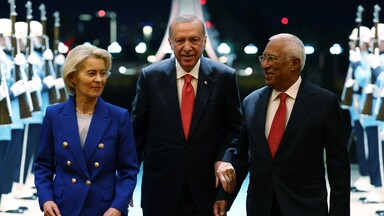
He noted that Syrian President Ahmed al-Sharaa was also in Ankara and said he would later attend a working dinner with EU leaders before hosting those of Montenegro, Slovakia and Albania on Thursday.
He announced that Türkiye will host two additional major international gatherings before the end of 2026: the 13th Summit of the Organization of Turkic States in Ankara on Oct. 29-30 and the COP31 UN Climate Summit in Antalya from Nov. 9 to 20.
Erdogan thanked NATO Secretary-General Mark Rutte, summit organizers and the people of Ankara for their role in hosting the event, saying they had once again demonstrated Türkiye's hospitality to the world.
Asked about his talks with Trump on the summit sidelines, Erdogan described the meeting as highly successful.
"It was a very, very productive meeting," he said. “Our joint press appearance covered a broad range of issues. Both President Trump and I answered all the necessary questions.”
Erdogan added that Trump appeared pleased following their discussions, having “left the press conference very happy.”
The Turkish president also said he did not discuss developments in the South Caucasus or the issue of the Greek Orthodox Halki Seminary with Trump during their meeting, but noted that the two leaders remain in close contact and can discuss regional issues by phone whenever necessary.
On relations with Greece, Erdogan welcomed Mitsotakis' recent remarks expressing a desire to resolve disputes over maritime jurisdiction in the Aegean Sea.
"I share Mr. Mitsotakis' view on resolving the issues in the Aegean Sea," Erdogan said.
Underlining that the two countries' foreign ministers would continue discussions, he said the leaders themselves may get involved directly if necessary.
"Resolving the issues in those waters is first and foremost the responsibility of the leaders. I share the same view," he said.
Asked about plans by Greece to extend its territorial waters and the longstanding "casus belli" dispute between the two countries, Erdogan called for direct dialogue instead of escalating tensions.
"Let us sit down, talk and resolve the issue," he said.
Erdogan also highlighted that the concept of the Blue Homeland (Mavi Vatan) remains an important element of Türkiye's maritime policy.
Turning to Türkiye's decades-long aim to join the EU, Erdogan said he would continue pressing European leaders to advance Ankara's accession process.
He said he had raised the issue with German Chancellor Friedrich Merz and planned to discuss it further with European Commission President Ursula von der Leyen and other EU leaders.
"We will tell them that making Türkiye wait for 53 years is an injustice. We will ask them to free Türkiye from this injustice," Erdogan said.
“I hope they will finally open the door.”
news_share_descriptionsubscription_contact