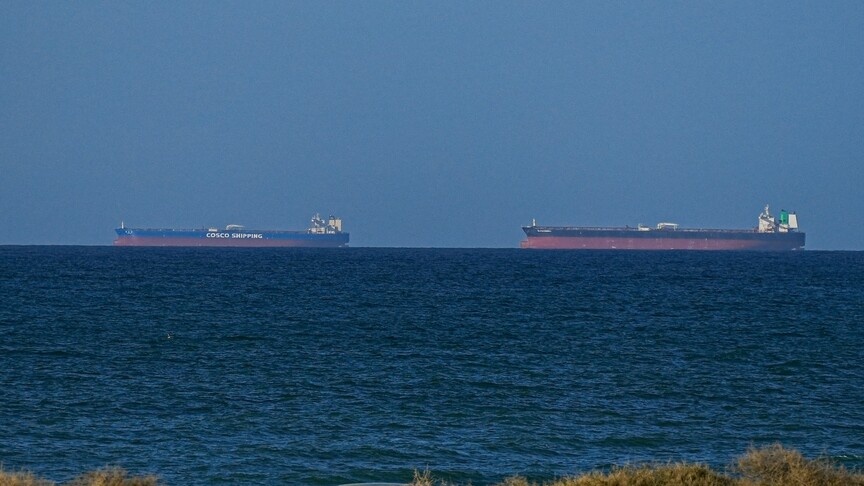
With commercial traffic in a chokehold in the Strait of Hormuz, a deeper question is emerging: when conflict erupts, do the rules of maritime law still hold?
Legal experts say the situation is no longer governed primarily by peacetime navigation rules under the United Nations Convention on the Law of the Sea (UNCLOS), but by the law of naval warfare.
Because of the ongoing conflict between the US, Israel and Iran, the law of armed conflict – or the law of naval warfare – is now the governing framework, Professor Natalie Klein of University of New South Wales’ Faculty of Law and Justice told Anadolu.The academic, who specializes in the law of the sea, said different laws apply to states that are party to the conflict and those that are neutral, making the situation even more complex for international shipping.
Iran, as a belligerent state, can take measures against vessels linked to its adversaries, she said. This includes not only warships but also merchant vessels.
"If they are flagged to the US or to Israel, then they are… enemy merchant vessels, and Iran is allowed to stop enemy merchant vessels,” she added.
But "the vast majority of those 3,000 or so ships” stranded in the Persian Gulf are flagged to neutral states, Klein said.
While Iran may “stop and search those ships,” she stressed that “it should not be targeting them and firing on them.”
Ship transits through the Strait of Hormuz remain at well below 10% of pre-crisis levels, according to UN assessments, as shipowners remain cautious amid high war-risk insurance costs and continued uncertainty.
The strait is a key artery for global oil shipments, making any disruption a major concern for energy markets and global trade, while higher energy, fertilizer, and transport costs may increase food costs and intensify cost-of-living pressures for the most vulnerable.
Iran blocked the strait as a retaliation to US and Israeli attacks in late February. After 39 days of war, a two-week ceasefire was reached and talks were held without any deal in Pakistan's capital Islamabad over the weekend.
But with the ceasefire set to expire on April 22, uncertainty surrounds the future course of events.
In a written response to Anadolu, UN Trade and Development (UNCTAD) acknowledged the legal complexity surrounding the strait, noting that "questions of customary international law are rarely straightforward" during periods of conflict.
The waterway is overlapped by the territorial waters of both Iran and Oman and governed by international navigation rules, with "differing interpretations" over whether coastal states can restrict passage on security grounds.
However, recent actions in the strait suggest those legal limits may have been exceeded.
"These rules have been violated because Iran threatened every single ship coming through, calling them military targets, and it's not supposed to do that," Klein said.
She drew attention to reports of commercial ships trying to get through the strait being fired upon.
She stressed that civilian crews should not be targeted. “They are not Navy personnel. They should not be targeted,” she said.
There are over 20,000 seafarers onboard those ships who are "essentially vulnerable to being attacked,” Klein said.
The key issue, she added, is the failure to distinguish between vessel types.
“It is correct to say that Iran can impose restrictions on shipping through the Strait of Hormuz… but it must distinguish between neutral merchant vessels and belligerent or enemy vessels.
"Iran threatens every single ship going through, … (and) is definitely going too far,” she said.
Klein said the situation is complicated by a fragile ceasefire, raising questions over whether wartime legal rules still apply or whether a return to peacetime frameworks should begin, as a definitive end to hostilities has yet to be established.
The issue in Hormuz has drawn further attention following remarks by President Donald Trump, who said the US would impose a naval blockade on Iran -- raising additional legal questions under international law.
US Central Command (CENTCOM) announced that it would begin enforcing a blockade on all maritime traffic entering and leaving Iranian ports starting Monday, while excluding vessels transiting the Strait of Hormuz to and from non-Iranian ports.
If military escalation and disruptions persist, UNCTAD said "the suffering will extend far beyond the region, translating into widespread economic hardship." Therefore, de-escalation and the restoration of stability are "essential."
Klein said possible solutions could include establishing a maritime safe corridor through international coordination as it has been proposed by a coalition including Bahrain, Singapore, Japan, Panama, and the UAE for the International Maritime Organization to establish.
According to her, another possible solution to ease shipping disruptions could involve using naval convoys led by neutral states.
However, she noted that such arrangements would require strict conditions and coordination.
"Normally, a neutral warship would only escort the vessels that are flagged to it, or there would need to be an agreement… and they would then need to give a lot of information to Iran to provide assurance that those ships being escorted do not carry goods that are going to benefit the enemy," she said.
Both options would require agreement from the parties involved, especially Iran and potentially Oman, she noted.
UNCTAD also highlighted ongoing efforts to address the crisis, noting that Secretary-General Antonio Guterres has established a dedicated task force for it.
Drawing on past initiatives such as the Black Sea grain deal brokered in 2022 with Türkiye, the task force is exploring a potential "Hormuz mechanism" aimed at facilitating the resumption of trade, particularly in fertilizers and related raw materials from the Arabian Peninsula, the agency said.
While international maritime law provides an essential framework, "it cannot, on its own, shield global trade from the effects of conflict," the agency said, adding that this can only be achieved through de-escalation and cooperation.
Klein expressed hope that the ceasefire will hold and provide a basis for a peaceful resolution for those who live in the region and beyond.
"The international legal system is not perfect, but those rules matter," Klein said.
news_share_descriptionsubscription_contact