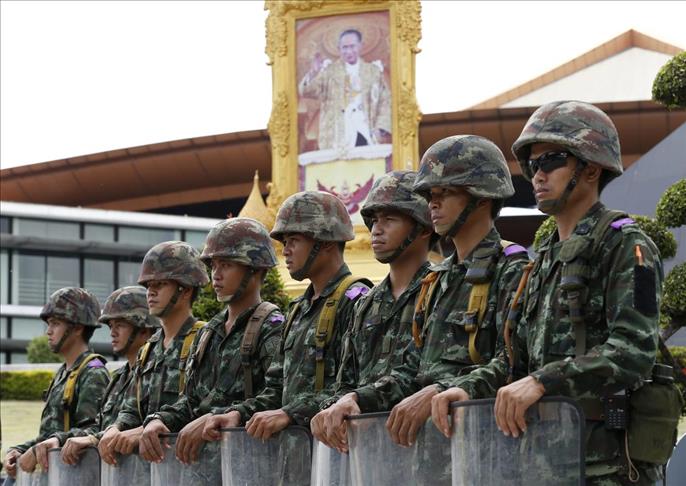
By CS Thana
BANGKOK
A Thai military court has sentenced 10 alleged members of an underground network set up to destabilize the country to up to five years in prison.
A court spokesperson who remained unnamed in accordance with protocol told Anadolu Agency that eight suspects were handed five-year terms and two others two-year terms early Tuesday morning.
They were found guilty of producing hundreds of video clips critical of the royal family and posting them on YouTube under the country’s harsh lese-majeste law and Computer Crimes Act, the Khaosod news website reported.
The two laws, which carry maximum sentences of 15 and five years respectively, are regularly used in combination, with the jail terms cumulated.
Tuesday’s sentences were reduced from ten- and six-years due to the suspects entering guilty pleas. They confessed they were behind the “Banpodj network,” a loose online affiliation that has produced anti-monarchy content and called for a republic.
The network was brought down after their 64-year-old leader Hasadin Uraipraiwan – who was among those handed a five-year term -- was arrested by a military-appointed task force in February.
Under Thailand’s lese-majeste law, it is not possible to detail the content of the controversial video clips as doing so would also be considered a violation.
The law, which can lead to imprisonment of between three and 15 years, is interpreted widely by courts and prohibits public discussion of the royal family.
"Banpodj network" message boards are renowned among "Red Shirts" -- supporters of the deposed Shinawatra clan, long at odds with the conservative establishment -- for comments critical of the country’s military junta and the rival Democrat Party.
The government of Yingluck Shinawatra -- the sister of Shinawatra clan head Thaksin, the establishment’s ten-year nemesis -- was overthrown by the ruling military junta in a May 22 coup.
Since the ruling Thai junta overthrew Yingluck's government, the number of cases of people detained for lese-majeste -- either awaiting trial or already sentenced -- has jumped.
According to ilaw, a local NGO monitoring political issues, more than 50 cases have been presented to court or are under investigation, compared to just a few before the coup.
Judges have also considerably extended the scope of the law, by including other members of the royal family -- beyond the king, the queen, the heir or the regent specified in article 112 -- and even monarchs who reigned centuries ago.