BANGKOK
In a rare display of public criticism, politicians from both sides of the political spectrum gathered Wednesday night to voice their objections to Thailand's new constitution.
The former ministers and MPs met at an event titled “The Future of Thai Politics” - the first of its kind since the May 22 coup.
The constitution is currently being drawn up for the military junta by a 36-member committee, and has to be finished by September.
“If this draft is adopted, there will be more conflict, not stability,” said Chaturon Chaisaeng, a former deputy-prime minister and member of the Puea Thai Party, whose government was overthrown last year.
His view was echoed by Kasit Piromya, a former minister of foreign affairs and member of the rival Democrat Party.
“When demonstrators were calling for reforms during the anti-government demonstrations, I thought the reform process would be a move towards more democracy, more accountability, not less," Piromya said.
"But now I fear we are going backwards, to a more guided-democracy... I don’t think it is acceptable to Thai society."
From Nov. 2013 to May 2014, massive anti-government demonstrations - supported by the Democrat Party and led by former Democrat MPs - called for “reforms before elections” and for the resignation of then Prime Minister Yingluck Shinawatra's government.
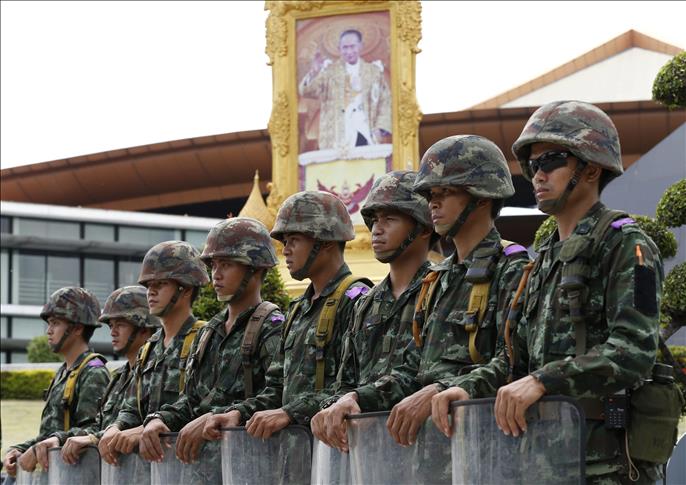
The junta seized power May 22 "to avoid bloodshed" - over 30 people had died during the demonstrations. It abolished the constitution, suspended both houses of parliament and imposed martial law across the country.
On Wednesday, former Puea Thai justice minister Pongthep Thepkanchana warned of future instability if the junta persists with the draft.
“The question is do the military and their allies trust and respect the people? The answer is 'no.' They took away some powers from people to give it to some specific groups,” he stated, at the event at the Foreign Correspondents Club of Thailand.
The military-appointed constitution-drafting committee is working on a charter blueprint that has to be approved by a 250 military-appointed member National Reconciliation Council by Sep. 4.
The committee has not consulted civil society organizations or political parties on the draft, while the junta refuses to bow to demands from all sides that the draft should be submitted to a popular referendum.
Among the latest proposals are a clause saying the prime minister could be a non-MP proposed by a majority of parliamentarians, while another stipulates that senate members be selected from pools of candidates nominated by ex-politicians and high-ranking civil servants - including military officers.
The committee has also proposed a German-style mixed-member proportional representation system for the elections, which would give more weight to small parties and result in coalition governments of multiple partners, as was the case in pre-1997 Thailand.
It also wants a council of “wise men” to be established to look after the implementation of reforms decided by the junta's National Reform Council over the coming years.
“According to the draft, people can vote, but in practice they cannot choose who will be the prime minister," said Chaisaeng.
"Worse, the government will not be able to formulate policies demanded by the people, because the reform plan [designed by the Reform Council] will have to be implemented for a period of five to ten years,” he added.
Of those invited to take part in the debate, just one spoke positively of the draft.
“The new Senate will be a house of citizens, in order to balance the house of politicians [the lower house], because we believe politicians are not honest enough,” said former Democrat MP and current Reform Council member Alongkorn Polabutr.
Most participants, however, were pessimistic about the Kingdom's political outlook.
“There is among some circles a rising conservative idea about a Chinese-like one party model-based on stability," said Piromya.
"That is dangerous for Thailand," he added.