Thai Red Shirt activist seeks asylum in Cambodia
Ekkapob Luara requests asylum after Thai junta issues warrant for his arrest for insulting country's monarchy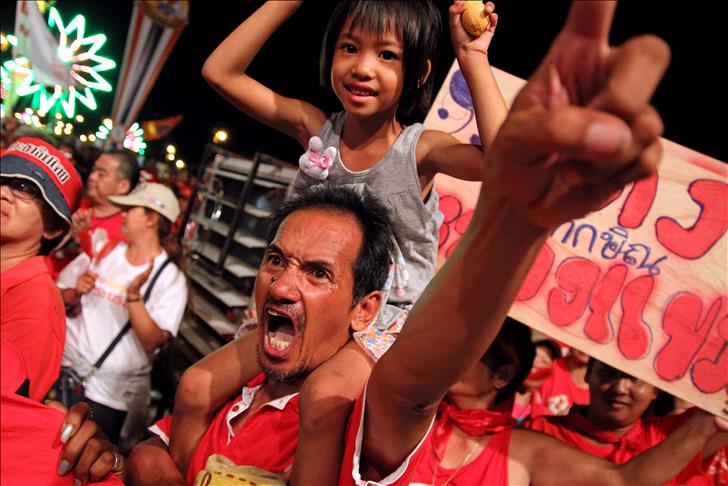
By Kate Bartlett
PHNOM PENH, Cambodia
A Thai activist is seeking asylum in Cambodia after being accused of insulting his country’s monarchy, a crime known as “lese-majeste,” The Cambodia Daily newspaper reported Thursday.
Kerm Sarin, head of the refugee bureau at the Cambodian Interior Ministry told the paper that the activist, Ekkapob Luara, was in the country and had put in an asylum request.
“He did apply. His application is under procedure… We have been checking for his [country of origin] information,” he said.
Sarin did not say whether or not Ekkapob would be granted asylum or sent back to face a warrant issued for his arrest by the new Thai military junta.
“We have to know whether it is a real case, why he is applying,” he said.
Although it is unclear exactly what comments Ekkapob, a vocational student, made that were considered derisive to Thailand’s beloved King, The Nation newspaper reported that he made them during a rally of “Red Shirts” - opponents of the military and bureaucratic establishment - last year.
Criticizing the king, the queen or the heir is punished by a jail term of between three to 15 years for each count and punishments are cumulative, according to Thai criminal law.
Earlier this year, after a May 22 military coup against the government of former Thai Premier Yingluck Shinawatra, Cambodian Prime Minister Hun Sen explicitly said he would not allow a Thai government-in-exile to be set up in Cambodia – despite having had warm relations with the toppled government that Red Shirts supported.
His comments came at the same time Jakraprob Penkair - a Red Shirt leader and a former spokesperson for ex-premier Thaksin, Yingluck’s elder brother who was overthrown in a 2006 coup - was in Cambodia.
Jakrapob was forced to leave Thailand after being accused of lese-majeste during a talk at Bangkok’s Foreign Correspondents Club in August 2007.
In the last four months alone, more than 14 people in Thailand have been charged with the crime, cases of which had already exploded since the coup against Thaksin.
An official at the Thai Embassy in capital Phnom Penh told the Anadolu Agency she was not authorized to comment on Ekkapob’s asylum bid Thursday.
Phay Siphan, spokesperson for the Council of Ministers, told AA that while he was not familiar with Ekkapob’s specific case, Cambodia and Thailand did share an extradition treaty.
Additionally, Siphan said, Cambodia’s foreign policy was not to interfere with any sovereign nation’s affairs.
However, he noted that in human rights cases “we do have a number of mechanisms—like the UN for refugees (UNHCR).”
Democracy activists have long called for at least a reform of the law as they claim it is used as a tool of repression by royalists seeking to undermine those who do not follow their point of view, while establishment supporters say it is needed to protect an institution attacked by ill-intentioned forces.
The charge has repeatedly been used to challenge the loyalty of the Shinawatra clan and more widely of the Red Shirts to the crown. But the Shinawatra governments had also not been averse to using the law against their own adversaries.