Khalid Mejdoub and Mohammad Sio
01 August 2026•Update: 01 August 2026
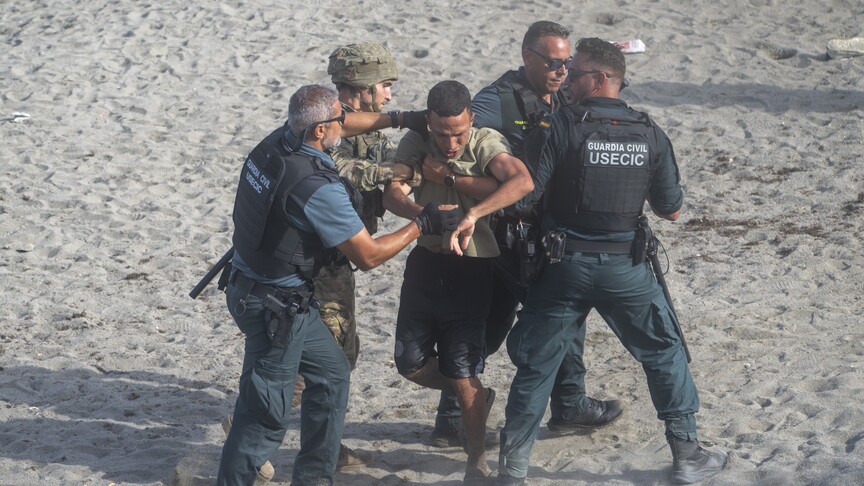
Two Moroccan men who returned home after entering the Spanish-administered enclave of Ceuta said harsh living conditions, food shortages and the inability to find shelter forced them to abandon their journey and return to Morocco.
The men told Anadolu the reality they encountered in Ceuta was vastly different from what they had expected before attempting the irregular crossing. They said they struggled to obtain necessities as shops remained closed and the city's streets became overwhelmed with new arrivals.
According to Spain's Interior Ministry, about 48,300 people returned to Morocco by 1600GMT Frida. Out of an estimated 60,000 who entered Ceuta in recent days, said the enclave's regional government chief.
'I couldn't even find a piece of bread'
Ayoub, 29, from the northwestern city of Larache, said he entered Ceuta on Thursday but stayed only one night.
He told Anadolu that he decided to head to the enclave after seeing large numbers of people crossing the border.
Others warned him not to remain on the streets because of the risk of violence, he said.
“The hardest part was not being able to secure even the most basic necessities,” he said. “I couldn't even find a piece of bread, so I decided to return to my country. It's better to go back home, eat a piece of bread and thank God.”
Ayoub said the experience was a lesson for him and for anyone considering irregular migration to Europe, describing conditions in Ceuta as far more difficult than he had imagined.
Many migrants were unable to find places to sleep and spent the night on the streets, he added.
'Lost inside Ceuta'
Othmane Assou, from the northwestern town of Moulay Bousselham, said he entered Ceuta with 10 friends but chose to return after discovering conditions were much worse than expected.
Assou said he works as an agricultural laborer in Morocco and earns about 100 Moroccan dirhams ($10) a day.
“One hundred dirhams a day is not enough to live on, and that's why I thought about migrating,” he said.
After arriving in Ceuta, he said, the group struggled to secure basic necessities because shops were closed and food was unavailable, prompting them to return to Morocco.
He described irregular migrants remaining inside Ceuta as “lost,” citing the lack of shelters and uncertainty about their futures.
Tensions continue at border
The Moroccan border town of Fnideq has witnessed repeated attempts in recent days by migrants seeking to enter Ceuta irregularly.
Security forces have reinforced their deployment along the border, preventing large numbers of people from approaching the fence separating the enclave from Morocco, according to an Anadolu correspondent.
The correspondent said tensions periodically flared between security forces and groups attempting to reach Ceuta. Some individuals also set fire to vehicles near the border crossing before security forces intervened and dispersed them.
Authorities continue to maintain heightened security measures in Fnideq and surrounding areas but have not yet issued a detailed statement on developments related to irregular migration at the border.
Tens of thousands of migrants who entered Ceuta have begun returning voluntarily to Morocco after facing shortages of food, shelter and basic services.
Death toll rises
The number of bodies recovered on the Spanish side of the border has risen to 57, while search operations continue amid fears that more victims remain missing.
Spanish authorities said some victims drowned while attempting to swim to Ceuta, while others died in stampedes near the border barrier.
In the last several days, tens of thousands of Moroccans have gathered near the border fence in an attempt to reach Ceuta and continue onward to Europe through irregular migration routes.
Ceuta and Melilla are Spanish-administered enclaves on Morocco's northern coast and constitute the European Union's only land borders with the African continent.