Seyit Kurt
08 June 2026•Update: 08 June 2026
Türkiye-backed zero waste projects are helping create jobs, build local capacity and turn waste into economic value in partner countries, speakers said Sunday at the Zero Waste Forum in Istanbul.
During the panel titled “How to Engage with the Zero Waste Approach in Development Cooperation: The TIKA Example,” speakers focused on translating waste policies into development outcomes through international cooperation.
Mert Yunus Balci, adviser to the president of the Türkiye’s Cooperation and Coordination Agency (TIKA), said zero waste has become a key development tool amid rising global waste and shrinking aid budgets.
He said global waste is expected to rise from 2.1 to 3.8 billion tons by 2050, with much of the increase in the Global South.
Balci said Türkiye’s Zero Waste Project, launched in 2017 under the leadership of first lady Emine Erdogan, has raised the country’s recovery rate from 13% to 37.5% and returned 90 million tons of waste to the economy.
TIKA has carried out more than 70 zero-waste projects in five years, focusing on local ownership, skills transfer, and sustainability rather than simple aid delivery.
“When a community produces, it owns. When it only receives, it creates dependency,” he said.
Balci added that impact is measured through jobs, women’s participation and youth skills, not only waste volumes, and said more than 40 new projects are planned in 25 countries in 2026.
Ateid Afaneh, executive director of the Joint Services Council for Solid Waste Management in Palestine’s Qalqilya District, said TIKA-supported equipment, including a cardboard baler, wood grinder and metal container workshop, has improved recycling capacity and created jobs despite severe infrastructure constraints.
He explained that the district, located in the northern West Bank, faces serious waste management challenges due to the Israeli separation wall and checkpoints.
In Kenya, Esther Iminza Andiva, deputy director of programs at MaMa Doing Good, said Nairobi generates between 2,500 and 3,000 metric tons of waste every day, while nearly 60% of Kenya’s municipal solid waste is organic.
She added that the capital’s large organic waste stream is being turned into economic value through black soldier fly farming, converting waste into animal feed and fertilizer, with TIKA support helping expand women-led initiatives.
Ibtissam Abdellaoui, research and analysis officer at Algeria’s Ministry of Education and Vocational Training, said recycling is being integrated with digital tools and vocational training to build a green skills ecosystem, including plastic recycling and prototyping through FabLab systems.
She stressed that recycling should not be viewed only as a waste management activity, but as a value creation sector supported by digital technologies, smart platforms and artificial intelligence.
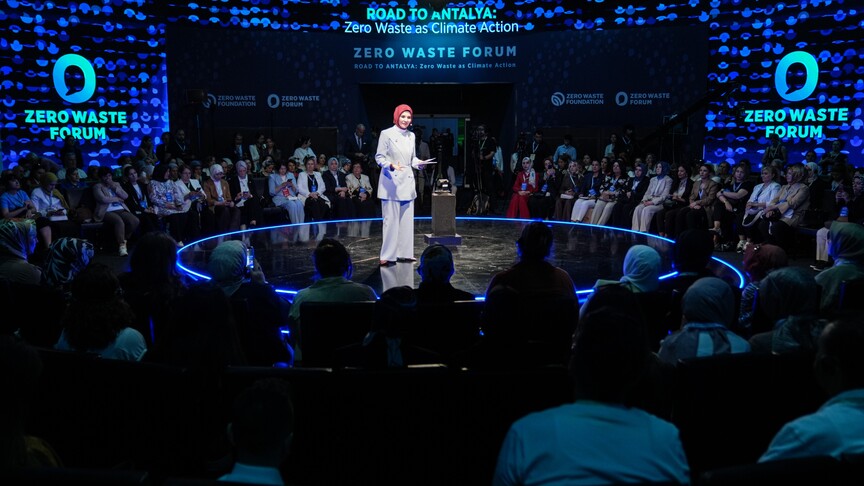
The Zero Waste Forum ran June 5-7 in Istanbul under the leadership of Türkiye’s first lady Emine Erdogan, who chairs the UN High-Level Advisory Board on Zero Waste and serves as honorary president of the Zero Waste Foundation, with support from UN agencies including UNEP and UN-Habitat.