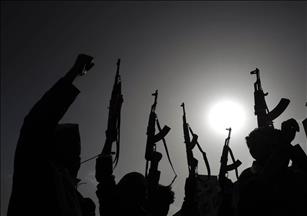
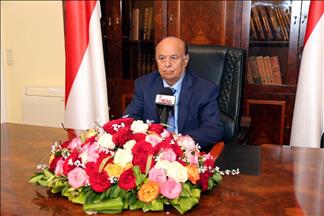
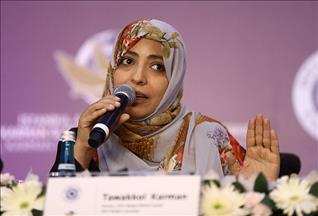
Yemen's Houthis dissolve parliament, form 'transitional' body
A Houthi representative read out the declaration in the presence of dozens of pro-Houthi political, military and tribal leaders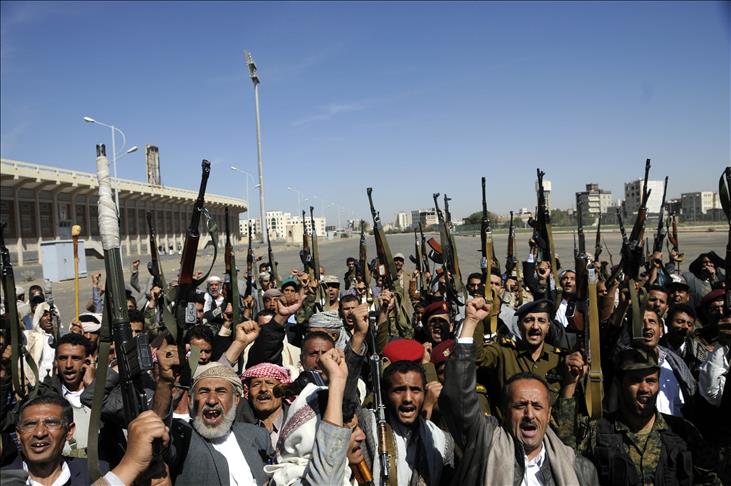
SANAA
Yemen's Shiite Houthi movement on Friday issued a "constitutional declaration" dissolving parliament and establishing a 551-member "transitional council."
At a ceremony held at Sanaa's presidential palace, a Houthi representative read out the declaration in the presence of dozens of pro-Houthi political, military and tribal leaders.
According to the declaration, pro-Houthi "revolutionary committees" – headed up by senior group member Mohamed Ali al-Houthi – will form a transitional council to replace parliament.
The transitional council will then elect a five-member presidential council tasked with running the nation's affairs for a two-year transitional period and drawing up a government of "technocrats."
The presidential council will also oversee the process of amending Yemen's constitution, according to the declaration.
The powers of the presidential council and government, meanwhile, will be spelled out by the Revolutionary Committee.
4 Yemen groups reject Houthi declaration
Two Yemeni political parties, along with the country's Revolution Youth Council and a southern separatist movement, have expressed their rejection of a "constitutional declaration" issued on Friday by the Shiite Houthi movement.
Yemen's Arab Socialist Baath Party also rejected the Houthis' declaration, describing it as a "coup against the regime and all regional and international agreements and protocols."
And while Yemen's Nasserist Unionist People's Organization did not declare an official position, it did call for an urgent meeting to "stand against the [Houthis'] constitutional declaration and forge a final position on it."
Sources close to the General People's Congress, led by former president Abdullah Saleh, told The Anadolu Agency that it would announce its position on the Houthi's declaration on Saturday.
A leading member of Yemen's Herak southern separatist movement, for his part, said the Houthi declaration "only concerns the north; it's not binding on the people of southern Yemen."
"This procedure and its aftermath only concern northern Yemen. As for the south, its plight is known and Herak is fighting to restore its independent state," separatist leader Ahmed al-Zubairi told AA.
Earlier Friday, the UN's envoy to Yemen, Jamal Benomar, reportedly left the country for Saudi Arabia for an unannounced visit, a government source told AA.
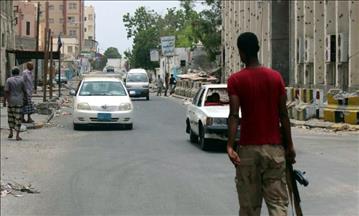
Before the constitutional declaration was issued on Friday, Houthi militants sealed streets leading to the presidential palace in Sanaa, eyewitnesses said.
The Shiite group emerged as a political and military force last September after taking over Sanaa and establishing control over other parts of the country.
The rise of the Houthis has pitted the Shiite group against local Sunni tribes and Al-Qaeda, the latter of which is said to still be active in the country.
Fractious Yemen has remained in turmoil since autocratic President Ali Abdullah Saleh stepped down in 2012 following a months-long popular uprising against his 33-year stint in power.